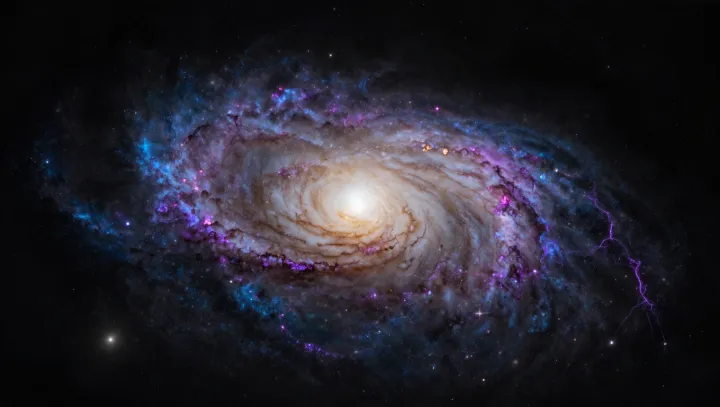
Pink is no decoration. Where hydrogen gas is struck by ultraviolet radiation from newly formed massive stars, it sheds energy through H-alpha emission, turning stellar birthplaces into rose-colored signals. Physics makes the hue. Blue arms make the sharper claim: their light is ruled by hot O- and B-type stars, whose brief lives prevent them from wandering far from the gas that made them.
That contrast is more revealing than a portrait. Spiral arms are not permanent material coils; in many galaxies, spiral density waves compress interstellar gas as it passes, increasing the chance of gravitational collapse and star formation. Their ultraviolet output ionizes nearby nebulae, supplying the same H-alpha signal seen in pink. The sorting is ruthless. Massive blue stars consume hydrogen fast, so their radiation marks the arms before orbital motion can smear the pattern, while older, cooler populations diffuse across the disk.
Color, however, is an argument rather than a census. Dust can absorb starlight, inclination can alter what a camera records, and filters isolate emission lines that the unaided eye would never separate. The distinction matters. Yet the basic reading holds: pink identifies ionized hydrogen around young stars, and blue identifies places where short-lived stellar mass still dominates the flux. A blue arm can look crowded even when the long-lived majority lies elsewhere, dimmer but far more numerous. That imbalance is telling. In the dark between arms, the galaxy keeps its older light, like an archive whose newest pages are burning.