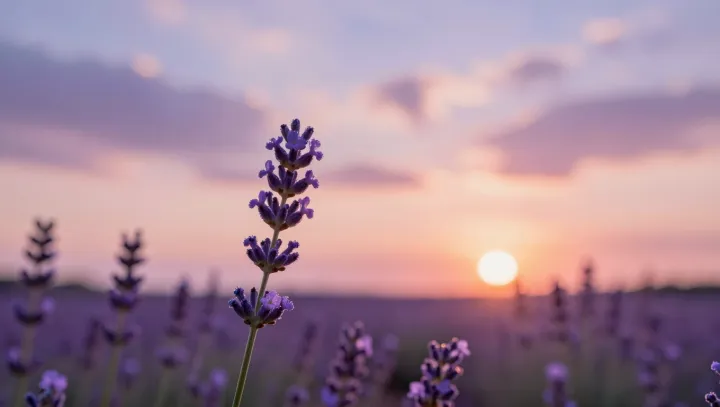
Calm is an optical trick. One lavender spike, held on the focal plane, keeps its tiny florets legible while the sunset behind it melts into a pastel wash; this is not serenity found in nature, but a frame's stern decision about what the eye may keep. The narrowing feels honest.
Focus is never neutral. With shallow depth of field, the lens admits a narrow zone of acceptable sharpness, while points beyond it expand into circles of confusion whose overlap produces bokeh; the background has not become gentle, only unresolved. The blur does the arguing. Not the sunset, but the aperture, governs the mood, which is why the same sky can read as restless at one setting and hushed at another. That is the manipulation. It removes horizon, scale, and visual clutter, leaving the flower to pose as the scene's solitary fact.
That restraint is the point. A wide aperture can make optical selection feel like emotion because the visual system reads sharp edges as priority and diffuse color as atmosphere; the photograph stages hierarchy before interpretation begins. No tranquil field exists here. The camera manufactures stillness without altering weather, wind, or color; it controls only the distribution of detail, then lets perception mistake selection for calm. There is one insistently rendered stem, and, around it, a world consenting to be forgotten.