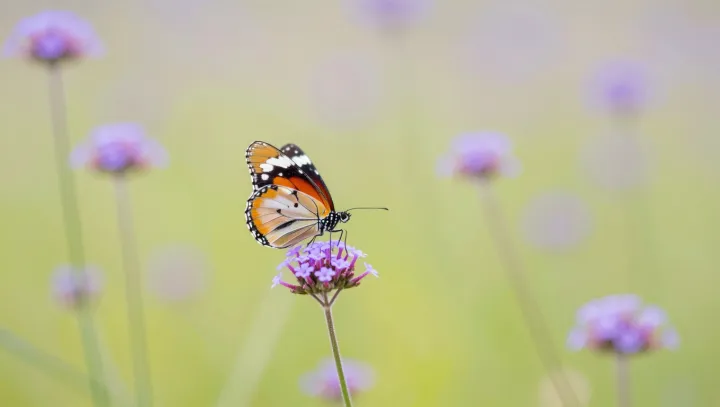
A blue flash is not always pigment. On a butterfly wing, microscopic scales can overturn the usual dye story: nanoscale structures sort incoming light and produce blue without a blue chemical. The color lives in geometry, not chemistry, and can change as the wing or viewer moves.
This is optical engineering at insect scale. In some species, chitin and air form repeating nanostructures, including photonic crystals or multilayer systems, whose refractive-index contrasts favor selected wavelengths. Coherent scattering can shape the effect as well. Think of each scale as a hardware light filter: rather than calculating pixels, it routes photons through spacing, angle, and interference. Move the wing, and the apparent hue may shift because the optical path shifts.
The trick is more than decoration. Pigment-free color offers a demanding model for coatings, sensors, and displays that use structure rather than chemical dyes, though copying it across large surfaces remains difficult. The payoff may include colors that resist fading and reduce some chemical inputs. That is a fabrication problem, not a marketing slogan. A butterfly does not manufacture blue; it compiles light into blue, with instructions written in nanometers.