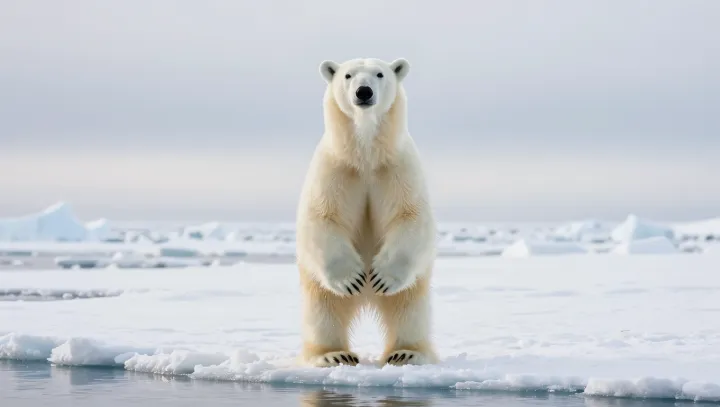
White is the illusion. A polar bear's coat contains no white pigment; its transparent hairs scatter visible light, producing the pale appearance that conceals black skin beneath. Color belongs to appearances. What looks like a straightforward paint job is instead an encounter between light and a dense covering of hairs, each contributing to the effect.
Transparency can be deceptive. Although an individual guard hair is largely transparent, light passing through the coat encounters numerous surfaces and internal structures that redirect it rather than allowing an unobstructed view of the skin. The distinction matters here. Pigmentation produces color through selective absorption of wavelengths, whereas multiple scattering sends a broad mixture of visible wavelengths back toward an observer, making the coat appear white. Context changes the result. Under different lighting or when the fur becomes dirty, that same bear can look yellowish or gray rather than cleanly white.
Black skin needs perspective. Its melanin absorbs light, but the familiar suggestion that every hollow hair acts as an optical fiber delivering sunlight efficiently to the skin overstates what the fur does. Warmth has other foundations. Dense underfur and guard hairs limit heat loss by retaining air, while a thick layer of body fat supplies additional thermal insulation in water and on ice. Appearance is not anatomy. The coat's whiteness also helps the bear blend with snow and ice, even though neither its transparent hairs nor its dark skin matches the color the eye assigns it.