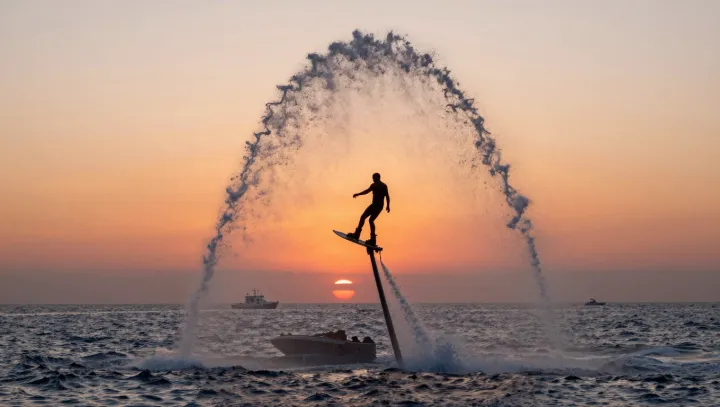
Flight here is borrowed. A flyboard rises without wings or onboard propellers because water, pumped through a hose and expelled beneath the rider's feet, produces an upward reaction force. The spectacle hides plumbing. What looks like freedom from gravity is instead a continuous exchange of momentum, with the board pushing water downward while the water pushes the board upward.
The hose deserves credit. In a typical setup, a personal watercraft supplies the pump power, sending pressurized water through the flexible connection to nozzles mounted beneath the board. Newton's third law applies. As those nozzles accelerate water downward, the resulting thrust must balance the weight of the rider and equipment to maintain a steady hover. Pressure alone explains little. The useful quantity is momentum flow: thrust depends largely on mass flow rate and jet velocity, so both the amount of water discharged and its speed matter, rather than pressure by itself.
Balance is the bargain. Because the thrust follows the jets' direction, tilting the board changes how much force acts upward and how much drives sideways motion, making the rider's posture part of the control system. Nothing escapes gravity here. The hose also adds drag and constrains movement, while interruptions in water delivery remove the force that keeps the rider aloft. Altitude has a price. Raising water and overcoming flow losses consume pump power, which helps explain why this apparent airborne freedom remains attached to machinery below. Above the surface, the tether draws its own quiet line through the illusion.