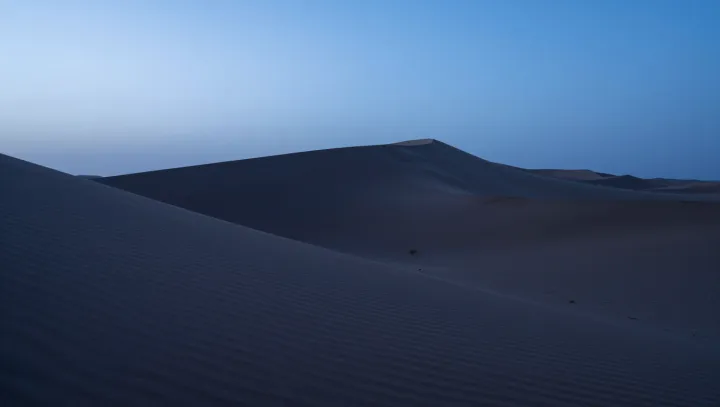
Less sand wins here. Crescent-shaped dunes, known as barchans, acquire their curves because the same wind carries their sand-poor horns forward faster than their sand-rich centers, making unequal movement the author of an apparently orderly shape. The edges pull ahead. No wind blowing around a corner is required to explain the crescent.
Bulk is a handicap. Where winds blow mainly from one direction and loose sand is limited, grains climb a dune's windward slope through saltation, a sequence of wind-driven hops that also dislodges other grains. The crest feeds avalanches. Sand crossing the crest falls or slides down the sheltered slip face, transferring material from the upwind side to the downwind side as the dune advances without preserving the positions of individual grains. Height slows the march. For comparable sand flux, a taller section requires more transported sand to shift its profile the same distance, while the lower horns can move farther with less material passing through them.
The curve records inequality. As the horns extend downwind and the thicker center trails, differences in migration speed help maintain the crescent, although changing winds, collisions and variations in sand supply can alter its proportions. Appearance can mislead here. A dune may look like a single solid object sliding across the ground, yet its motion comes from grains repeatedly leaving one surface and joining another, with no permanent membership in the moving form. Stillness is the illusion. Beneath the clean crescent lies a quiet discrepancy: the fullest part is the part that cannot keep up.