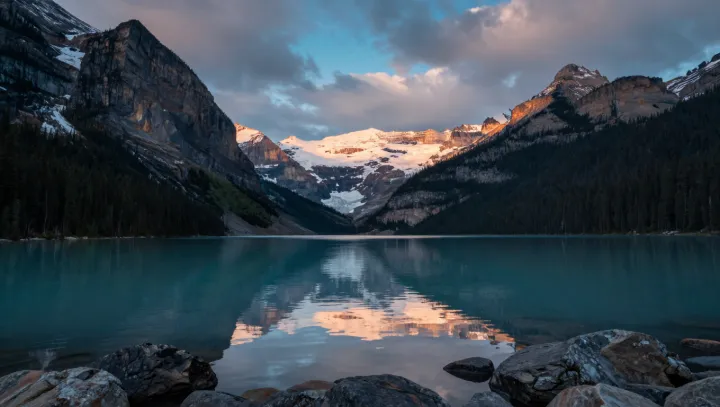
The sky deserves less credit. Lake Louise owes its turquoise appearance chiefly to rock flour, the fine mineral particles that glaciers grind from bedrock and meltwater carries into the lake, where they remain suspended and scatter incoming sunlight. Stone supplies the spectacle. What looks like borrowed blue is largely an optical effect within the water itself.
The beauty begins with abrasion. As glacial ice moves across its bed, rock fragments embedded in the ice scrape and crush the underlying stone, producing sediment fine enough for some particles to stay suspended rather than settle immediately. Meltwater delivers the powder. At Lake Louise, in Canada's Banff National Park, this suspended sediment redirects sunlight through scattering, while the water absorbs longer wavelengths, including red, more strongly than shorter ones. Absorption helps shape the color. The turquoise that reaches an observer's eyes therefore comes from the interaction of mineral particles, water and light, not from a simple mirror image of the atmosphere overhead.
The color is no guarantee. Its intensity changes with the supply and concentration of sediment, the depth of the water and the illumination, so the lake need not display the same shade under every viewing condition. Reflections still have a role. Clouds, surface ripples and viewing angle can alter what visitors see, but those effects should not be mistaken for the source of the lake's characteristic turquoise. Clear water behaves quite differently. Without the glacier's suspended mineral cargo, the same basin would lack this particular milky brilliance: the mountain's slow destruction, made briefly visible as light.