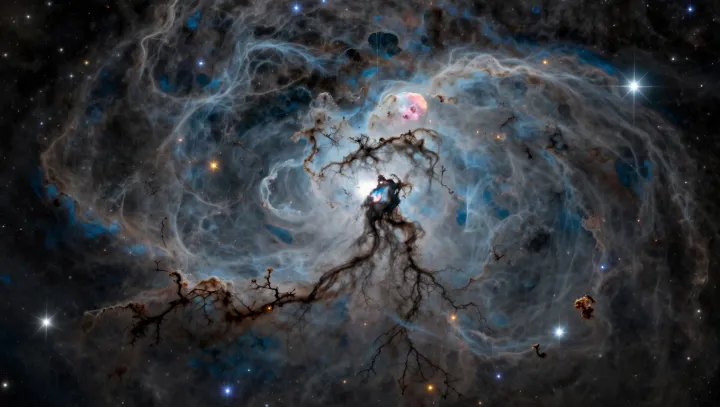
The darkness is matter. Rather than marking empty space, the dark patches in this Hubble image reveal dust clouds that interrupt light arriving from stars and other sources behind them. Absence is the illusion. What looks like a hole is instead an obstruction, whose visibility depends on the contrast between the cloud and the light beyond it.
Dust makes darkness informative. Through absorption and scattering, grains remove light from the direct line of sight, producing what astronomers call extinction rather than an actual shortage of objects behind the cloud. Size changes the effect. Because dust generally obstructs shorter wavelengths more strongly than longer ones, background sources can appear both dimmer and redder, although the result depends on the grains and the amount of material along the viewing direction. Blackness has its limits. A patch's apparent depth cannot, by itself, establish how much dust it contains, since the brightness of the background also shapes the visible contrast.
The image withholds evidence. Observations of infrared radiation can penetrate some dusty regions more effectively than visible light, allowing astronomers to investigate sources that an optical image leaves concealed. Not everything becomes transparent. Dense clouds can still obstruct infrared light, and interpreting any revealed structure requires attention to wavelength rather than the assumption that another instrument simply removes the curtain. Darkness deserves another reading. Dust is a small component of interstellar matter, yet its ability to intercept light lets it dominate the appearance of a region whose contents remain partly hidden. Beyond the cloud, the stars need not have gone anywhere.