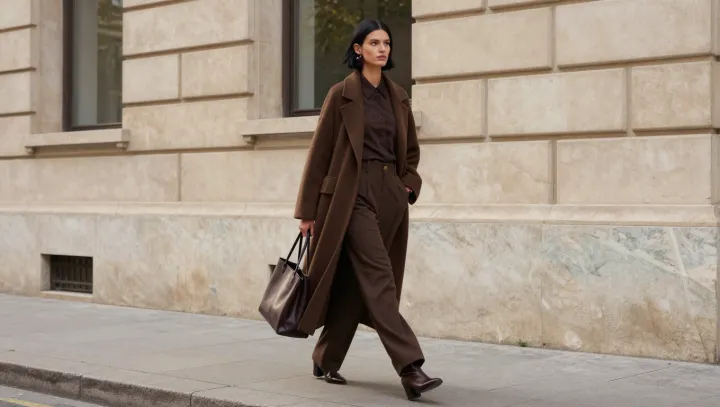
Restraint beats a bright accent. A dark brown coat needs no competing color when the clothes beneath it establish differences in shade, surface, and shape, giving the eye something to follow without breaking the palette. Exact matching looks flatter. Against an espresso wool coat, an oatmeal knit and tobacco trousers create separation while keeping the outfit recognizably tonal.
Texture does the quiet work. Where several browns sit close together, brushed wool, ribbed knitwear, and smooth leather distinguish themselves through their surfaces, which catch and scatter light differently. The differences need not shout. A suede boot beside a wool trouser offers a softer boundary than polished leather, while a chunky sweater introduces visible relief beneath a coat's comparatively even finish. Nap changes the reading. Because raised fibers can appear lighter or darker depending on their direction and the light, a brushed fabric may supply variation without introducing another color.
Proportion deserves equal billing. When a coat has generous volume, trousers with a controlled line can keep the outfit from becoming an undifferentiated block, while a closer coat can accommodate a fuller trouser whose drape remains visible below the hem. Length makes the distinction. A sweater ending above the coat's hem, or a cuff revealing the boot, gives each layer a readable edge rather than allowing brown to swallow brown. Accessories should earn their place. A belt or bag works best when its finish adds contrast already missing from the clothes; the coat remains the darkest note, but no longer the only one.