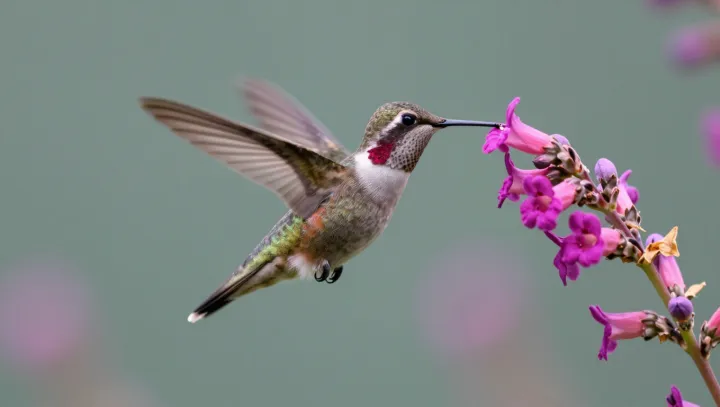
The return stroke works. Unlike most birds, hummingbirds generate substantial upward force during both halves of a wingbeat because their wings rotate between sweeps, presenting a suitable angle of attack as their direction reverses. Speed alone explains little. During hovering, the wings sweep roughly horizontally, so the familiar labels downstroke and upstroke conceal a more interesting maneuver than simple vertical flapping.
The shoulder deserves credit. Its exceptional mobility lets the wing rotate through the stroke reversal, while the relatively stiff, extended wing retains an aerodynamic surface instead of folding away for the return journey. Orientation changes the result. By changing wing pitch, the bird redirects aerodynamic force upward on each sweep, even though airflow across the wing reverses direction. Lift follows relative airflow. The angle of attack, measured between the wing's chord and the oncoming air, helps determine that force; unsteady airflow, including a leading-edge vortex, can strengthen force production during hovering.
The bargain remains unequal. Measurements of hovering hummingbirds show that the downstroke generally supplies more weight support than the upstroke, reflecting differences in wing shape, deformation, and aerodynamic performance between the two sweeps. Most birds economize differently. They flex or partially fold their wings during recovery, reducing resistance rather than producing comparable upward force, although some species also obtain useful aerodynamic forces on the upstroke. Hovering demands another arrangement. With little forward motion to sustain airflow, hummingbirds keep both sweeps productive, buying suspension with continuous muscular effort while the body appears almost still.