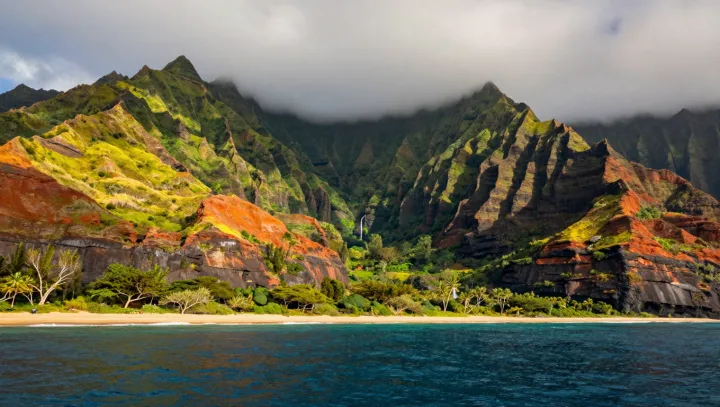
Water deserves the credit. Although volcanic eruptions supplied Kauai's basalt foundations, rainfall, rivers, and surf helped turn that accumulated rock into the Napali Coast's towering cliffs and deeply incised valleys. Solidity proved no defense. Beneath the apparent permanence of stone lies a vulnerability: water can alter its minerals, carry away loosened material, and exploit fractures that become routes for further attack.
Rain is no bystander. Through chemical weathering, including hydrolysis, water reacts with minerals in basalt, producing clays and weakening rock that streams can then abrade with transported sediment as runoff gathers in channels and moves downhill toward the sea. Gravity joins the excavation. Where erosion undercuts slopes or prolonged rainfall raises water pressure within them, mass wasting shifts rock and soil downslope, widening valleys and exposing fresh surfaces to weathering rather than leaving rivers to perform the entire task alone.
The coast resists completion. At the shoreline, wave erosion attacks exposed rock and removes debris, while inland drainage cuts into the volcanic mass, leaving ridges between valleys whose narrow profiles reflect the uneven removal of material across the island's flank. Height records what survived. Not a single sculpting event but repeated interactions among weathering, stream incision, slope failure, and surf explain the coast's form, with differences in rock strength and fracture patterns helping determine which walls persist and which sections yield to erosion. The cliffs stand above the water, their seeming permanence purchased by everything that has already fallen.