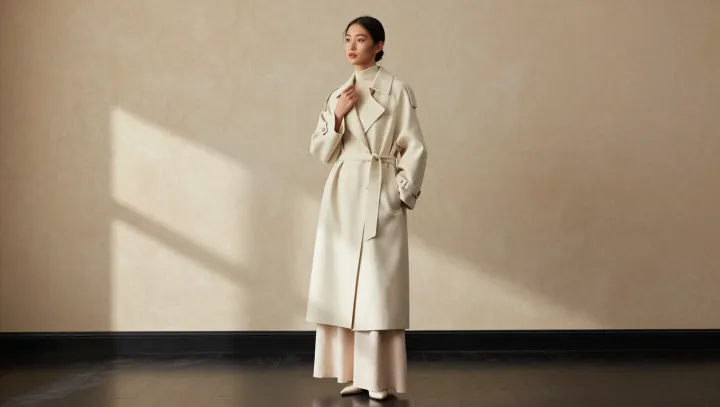
White deserves less blame. A long, all-white outfit can look sleek rather than bulky when its cut gives the eye a waist to register and an uninterrupted line to follow. Shape does the work. Although pale fabric can make folds and surface details more noticeable, visibility is not the same thing as an oversized silhouette.
The waist earns attention. By drawing fabric inward between the rib cage and hips, a fitted seam or restrained belt establishes a change in width that prevents a long garment from reading as one undifferentiated block. Tightness is not required. Princess seams, which run vertically through the bodice, can supply definition without the bunching that an aggressively cinched belt sometimes creates. Excess fabric adds noise. When sleeves, shoulders and the midsection all carry generous volume, the outline may broaden even if the garment is black; white merely receives the accusation more readily.
Length needs a route. A continuous white column avoids the strong color break between a contrasting top and bottom, while an open coat, straight trouser crease or vertical seam can reinforce its downward direction. Fabric must cooperate too. Drape determines whether material falls close to the body or projects outward, so a fluid cloth and a stiff, voluminous cloth can produce different outlines in the same shade. Details can interrupt everything. Bulging pockets, stacked hems and thick horizontal trim compete with that length, leaving the brightest outfit looking less like a column than a collection of ledges.