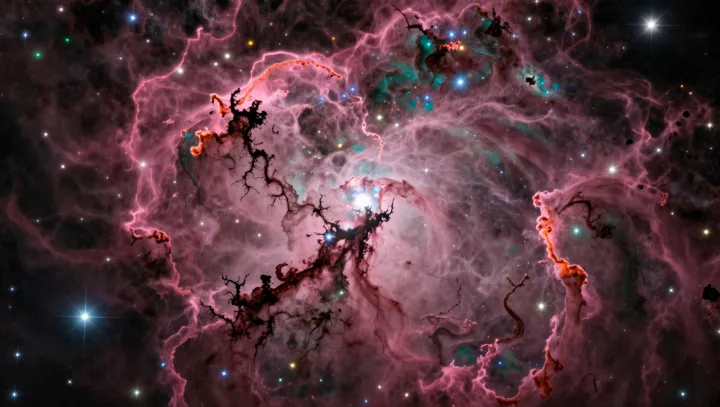
The nursery is disappearing. Young stars are eroding the cloud that formed them, as radiation heats exposed gas and outflows push against the material still surrounding their birth sites. Creation carries its costs. Along the cloud's ragged boundaries, the same stars that emerged from collapsing gas now help determine how much of that gas can remain available for another round of star formation.
Those edges are evidence. Through photoionization, energetic ultraviolet photons strip electrons from atoms, heating exposed gas so that it expands and can escape from the cloud's surface. Shadows resist the assault. Denser clumps can shield material behind them, leaving protrusions and uneven boundaries as less protected gas is removed by a process called photoevaporation. Outflows add mechanical force. Gas expelled by young stars can drive shocks into surrounding material, transferring momentum and opening cavities whose shapes depend on the cloud's density and the direction of the escaping flow.
Destruction is not straightforward. Stellar feedback can disperse the gas needed for collapse, but pressure from expanding heated regions and shocks can also compress nearby material, potentially encouraging collapse where conditions permit. Compression guarantees no stars. Whether a squeezed clump becomes gravitationally unstable depends on its mass, temperature, magnetic support and internal motions, not simply on its proximity to a bright source. The boundary records competing pressures. Where radiation reaches an exposed surface and outflows encounter resistant gas, the cloud's changing outline marks the uneasy border between matter that might form stars and matter those stars send away.