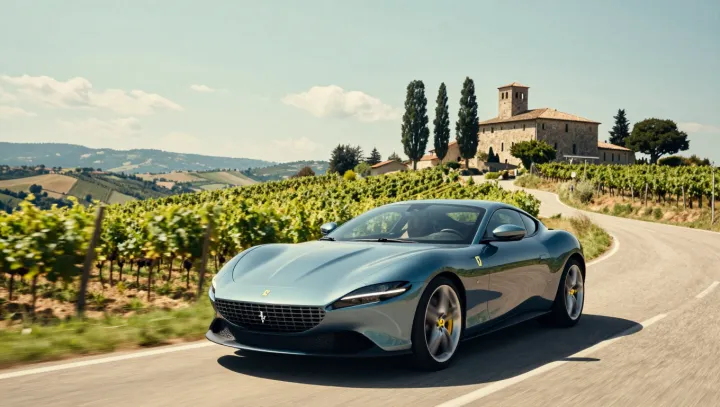
More grip carries baggage. The Ferrari Roma's rear spoiler stays lowered when extra downforce would offer too little benefit to justify the aerodynamic drag that comes with it. That is not wasted potential: it is the point of active aerodynamics, which adjusts the car's bodywork to suit the driving conditions rather than one permanent compromise.
Downforce is not free. By changing airflow and the pressure distribution around the rear bodywork, the deployed spoiler increases the downward aerodynamic force acting on the car, helping the rear tires generate cornering force. Drag pushes backward instead. Although both forces depend on airflow, they serve different purposes: one can improve road holding, while the other demands engine power merely to maintain speed. Speed makes that expensive. For a fixed aerodynamic configuration, drag rises approximately with the square of airspeed, and the power needed to overcome it rises approximately with the cube, making unnecessary deployment increasingly costly as speed builds.
Restraint is the engineering. The Roma's spoiler has low-drag, medium-downforce and high-downforce positions, with its control system selecting among them according to speed and driving demands, including acceleration and braking. Deployment is not automatic theater. During demanding maneuvers, additional rear aerodynamic load can support stability and grip; when that load is less useful, a lower-drag setting reduces the penalty to efficiency and performance. Balance matters as well. More rear downforce alone does not guarantee a better-handling car, because front-to-rear aerodynamic balance also shapes its response. The quietest piece of bodywork may be the one doing its job best.