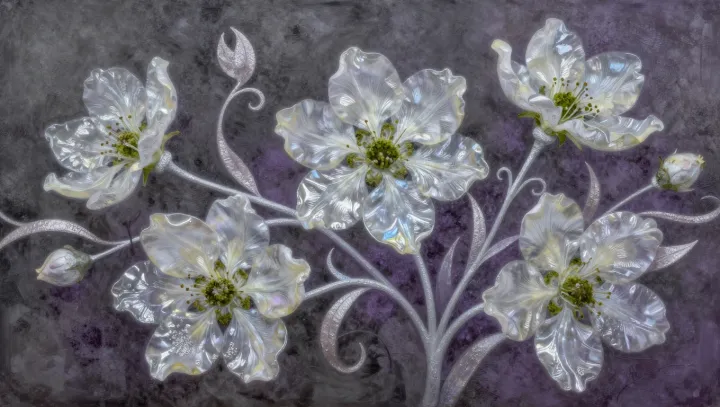
The flowers need no paint. Where a gray wash stops around petal-shaped patches of untouched paper, the eye reads blossoms rather than omissions, because the surrounding marks supply boundaries that the blank surface alone cannot offer. Absence does the work. This technique, called negative painting, gives the background an unusual assignment: describing what the brush refuses to touch.
The blankness is not passive. Through figure-ground perception, the visual system separates an apparent object from its surroundings, allowing enclosed or partly enclosed pale shapes to register as petals against a darker field. Contrast strengthens the effect. Simultaneous contrast makes the same paper appear brighter beside gray ink than beside another unpainted area, although its reflectance has not changed. Edges carry the argument. A narrow gray passage between two reserved shapes can suggest overlapping petals, while a broken boundary can let a blossom merge with the surrounding light instead of looking cut out.
Restraint demands more planning. Before laying down a diluted ink wash, the painter must decide which patches will remain untouched, since ink absorbed into paper cannot simply be lifted away to restore the original surface. Water changes the edges. A wetter surface encourages spreading and softer boundaries, whereas a drier surface generally gives the brush more control over the outlines that separate petals from their setting. Uniform outlines risk stiffness. Varying the gray values and leaving some edges unresolved can suggest depth without filling the flowers themselves. The brush departs at the petal's edge, leaving the paper to hold the light.