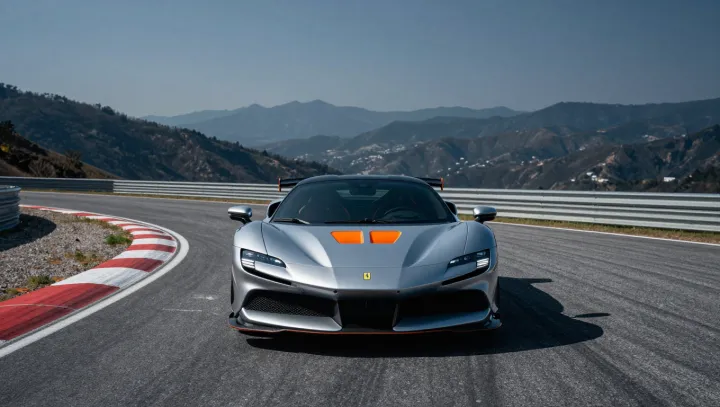
Low resistance is overrated. For the Ferrari SF90 XX Stradale, which must turn and stop rather than merely chase speed, air is valuable precisely because it can press the car downward. Grip earns its keep. Ferrari quotes 530 kilograms of downforce at 250 kilometers per hour, an aerodynamic load that pushes the tires harder against the road without adding vehicle mass.
The wing deserves attention. Its fixed rear aerofoil, working with the front aerodynamic devices and underbody, establishes pressure differences and redirects airflow so that the resulting aerodynamic force presses downward. Physics supplies the pressure. This downforce increases the tires' normal force, allowing them to generate greater cornering and braking forces before reaching their adhesion limits, although rubber does not deliver grip in direct proportion to load. Balance matters just as much. By distributing aerodynamic load between the axles, Ferrari helps prevent one end from running out of grip well before the other during demanding maneuvers.
Free grip is fiction. Generating downforce generally brings aerodynamic drag, which consumes power and can reduce straight-line speed, but a car built for fast laps can recover that cost through faster corners and stronger high-speed braking. Speed changes the bargain. Because aerodynamic forces grow roughly with the square of speed when other conditions remain similar, the extra loading becomes much more effective as velocity rises; it offers little assistance in a slow bend. Weight would charge twice. Added mass increases inertia during acceleration, braking and turning, whereas downforce supplies speed-dependent loading without that mass penalty. The road receives an invisible weight.