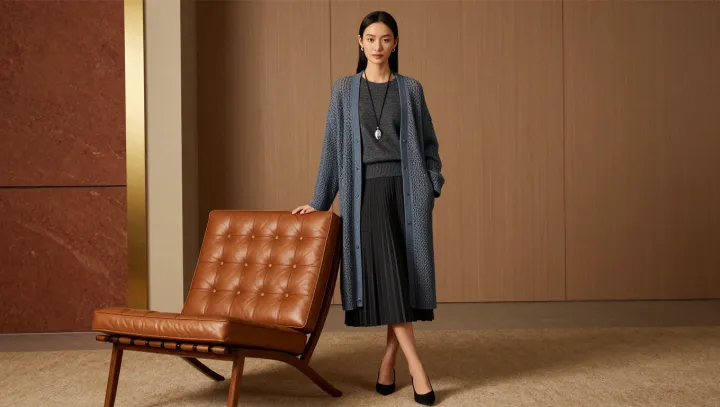
Contrast beats subtracting layers. A gray cardigan over a pleated skirt looks less bulky when the inner top fits closely and the waist remains visible beneath the knit. Volume needs a boundary. Without that distinction, the cardigan and skirt can read as one uninterrupted block, even when neither garment is particularly heavy. Pleats need their freedom. Their folds should drop below the waistband rather than bunch beneath a sweater hem.
The waist deserves priority. A fitted jersey top supplies a relatively smooth base, while a cardigan worn open allows the waistband to mark where the skirt begins. Precision need not pinch. A small front tuck can suggest that division, provided the knit is thin enough to sit inside the waistband without creating a lump. Length changes the balance. A cardigan ending near the waist leaves more pleats visible, whereas a longer style benefits from an open front that reveals the fitted layer underneath.
Fabric matters more than labels. A skirt with supple drape can move beneath knitwear, but stiff fabric or crowded knife pleats may stand away from the hips instead. Check the side view. If the cardigan catches on the skirt, adjust its hem or leave it open rather than tightening a belt around both layers. Color can stay quiet. Gray over gray can work when texture and fit separate the pieces; a contrasting inner top simply makes that separation easier to see. The folds finish the argument. Beneath the stillness of the cardigan, the skirt should retain enough room to move.