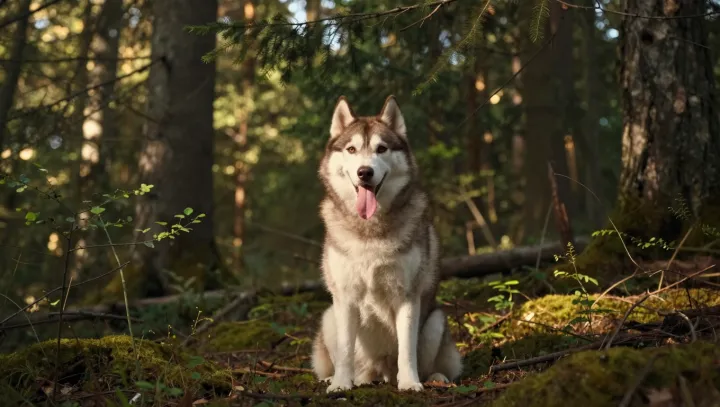
Ice-blue eyes contain no blue. A Siberian Husky's signature stare gets its color from the way light interacts with iris tissue, rather than from any blue substance stored inside it. The distinction changes everything. Where brown eyes owe much of their appearance to melanin, blue eyes reveal what happens when that pigment is scarce in the iris's front layers.
Absence does the work. When light enters the iris's stroma, the connective tissue beneath its front surface, shorter wavelengths are scattered more strongly than longer ones, giving the returning light a bluish appearance. This is structural coloration. Unlike paint, which gets its color through selective absorption by pigments, the blue depends on tissue structure and the wavelengths redirected toward an observer's eye. Blue needs no dye. The iris's rear pigment layer generally remains dark, absorbing much of the light that passes deeper rather than supplying the blue itself.
Genetics sets the conditions. In Siberian Huskies, a DNA duplication near ALX4, a gene involved in development, is strongly associated with blue eyes, although association alone does not establish every biological step. The switch remains complicated. That variant is thought to influence pigmentation in the iris, but inheritance is not perfectly predictive, and other genetic routes can produce blue eyes in dogs. One face can differ. Unequal pigmentation can also leave a dog with one brown eye and one blue eye, a condition called heterochromia, or with differently colored areas within an iris. Light supplies the finish. Beneath the same gaze, one eye may hold its color in pigment while the other borrows its blue from light.