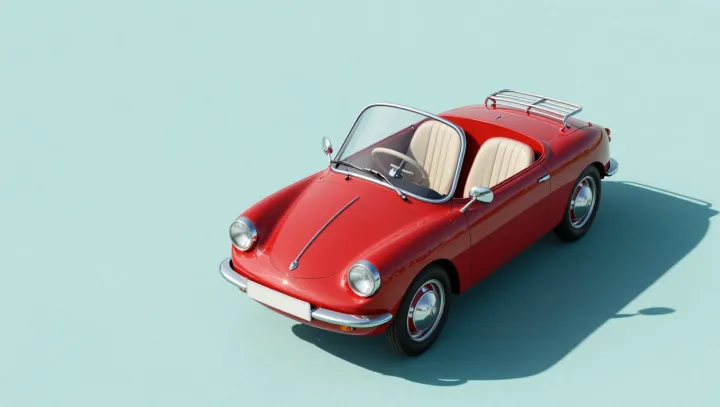
Sideways space was expendable. The Messerschmitt KR200 placed its passenger behind the driver rather than alongside, turning an unconventional seating arrangement into a practical means of keeping its three-wheeled body narrow. Less width meant less frontal area, the projected surface that meets the airflow as a vehicle moves forward through it.
The physics rewards restraint. Aerodynamic drag depends on air density, speed squared, drag coefficient and frontal area, so reducing the last of these can lower resistance without requiring a more powerful engine. Narrowness alone proves little. A vehicle's drag coefficient still depends on its shape and airflow, which means the KR200's seating arrangement should not be mistaken for evidence of exceptional aerodynamic efficiency by itself. Nevertheless, tandem seating addressed a basic packaging problem: accommodating two occupants without placing two adult bodies across the cabin at shoulder height. Behind the unusual silhouette lay a straightforward exercise in allocating scarce space.
Economy had a price. The passenger surrendered the familiar position beside the driver, while conversation and companionship took a different physical form inside a cabin arranged along its length. This was no miniature saloon. With two wheels at the front and one at the rear, the KR200 combined its seating arrangement with a three-wheel chassis rather than simply shrinking the conventional four-wheel car. Its appeal rests partly in that refusal to preserve every familiar convenience when dimensions were tight. The empty place beside the driver was not missing accommodation; it was width the car had chosen not to carry.