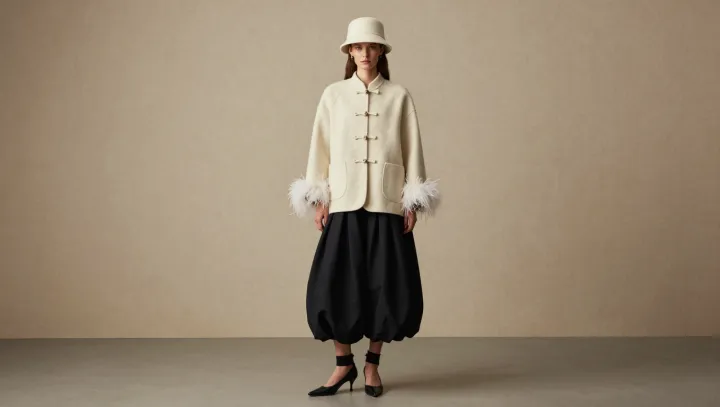
Monochrome makes ornament work. When black and white replace a crowded palette, the eye has fewer competing signals to process, so a raised closure, curved seam or projecting sleeve becomes easier to distinguish. Restraint does the editing. What might otherwise register as decoration begins to read as construction, giving familiar details an unexpectedly contemporary edge.
The closure becomes architecture. Against a white jacket, a black loop fastening marks both the point where fabric joins and the direction in which the garment opens, turning a practical device into a graphic accent. Contrast exposes the decisions. Pattern cutting, which determines how flat pieces form volume around the body, becomes more legible when contrasting panels or edges reveal its contours. Not every seam emerges. An uninterrupted black surface can conceal stitching, while a white insert can draw attention to an asymmetric opening or the sweep of a shaped hem. Simplicity is not emptiness. It is a selective arrangement of emphasis, with some details pushed forward and others allowed to recede.
Modernity needs more than subtraction. Fabric weight and drape still determine whether a sculpted sleeve holds its shape, while surface texture can distinguish two adjoining black panels without adding another color. Finish carries the argument. Uneven piping or a collapsing collar has little visual cover when the palette offers no print to divert attention from the garment's edges. Precision earns its place. At the shoulder, where a white plane meets a black curve, the garment seems suspended between something worn and something built.