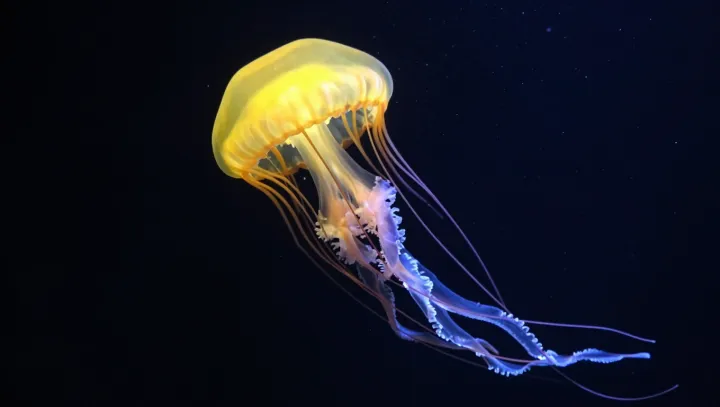
A brain is optional. For jellyfish, whose swimming depends on coordinated muscle contractions rather than commands from a central organ, control is distributed through nerve networks spread across the body. Order needs no headquarters. In many familiar species, structures around the bell's edge generate the signals that set each swimming pulse in motion.
Decentralization is not disorder. In moon jellyfish and other scyphozoans, sensory structures called rhopalia contain pacemaker centers, whose electrical activity initiates signals that spread through a motor nerve net and recruit swimming muscles across the bell. The pulse spreads outward. As muscle fibers contract, the bell narrows and pushes water away, producing thrust; when those muscles relax, elastic tissue helps restore the bell's shape. Rhythm does the work. Multiple pulse-generating centers can influence the same network, so coordinated movement does not require a single permanent commander issuing instructions to every muscle.
Grace is partly mechanics. The gelatinous tissue called mesoglea stores and releases elastic energy, while water moving around the bell can help carry the animal between contractions, reducing the muscular effort needed for travel. Sensation still shapes movement. Rhopalia can house balance organs called statocysts and, depending on the species, light-sensitive structures that supply information about orientation and surroundings. Brainless does not mean unresponsive. Different jellyfish possess different neural arrangements, and some adjust turning through uneven contractions rather than pulsing identically on every side. Beneath the drifting bell, authority remains scattered, yet the animal moves as one.