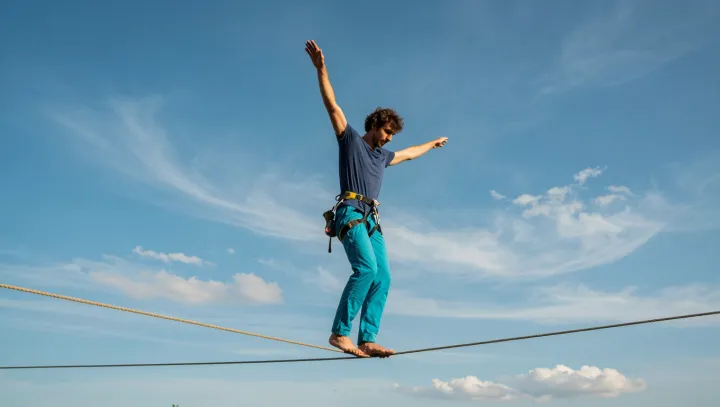
Stillness is the illusion. On a highline, the appearance of composure comes from small, continuing adjustments, as the suspended webbing shifts beneath the feet and the body responds through movements of the arms, hips and legs. Balance requires this exchange. Rather than holding a pose against an obedient surface, the highliner must coordinate movement with a support that also moves under pressure.
Wobbling need not mean failure. Because the line yields sideways and downward under load, a correction changes both the body's position and the support beneath it, setting up another adjustment rather than restoring permanent rest. The feet report back. Proprioception, the sense of body position and movement, combines with sight and signals from the inner ear to help the nervous system track what is happening. The arms contribute too. By changing their position and motion, highliners redistribute angular momentum, influencing how the torso rotates while the feet remain on the webbing.
Control is not rigidity. A body held stiffly has fewer ways to accommodate a moving support, whereas coordinated adjustments across several joints allow the highliner to respond without treating every disturbance as a separate emergency. Timing matters as well. Since the line responds to forces from the person standing on it, an adjustment can settle one motion while feeding another, making the relationship between body and webbing inseparable. The still photograph cheats. What it preserves as a figure suspended above empty air is actually a negotiation whose terms change beneath every footstep.