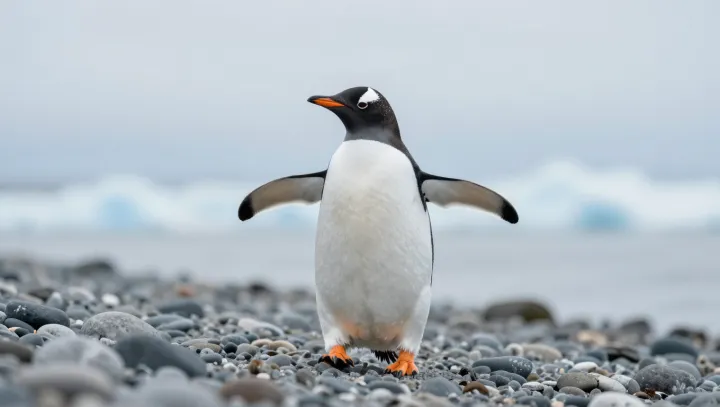
Flightlessness is no defeat. Gentoo penguins propel themselves underwater with wings that have become stiff, flattened flippers, trading the flexibility needed for aerial flight for structures that withstand water's much greater resistance. Their flight runs deeper. Rather than merely paddling backward, these birds sweep their flippers through the water, producing forces that drive their bodies forward.
The trick is angle. Each flipper acts as a hydrofoil, a surface that generates hydrodynamic lift as water flows around it, with the resulting force directed partly forward rather than simply upward. Both strokes earn propulsion. By changing the flipper's angle of attack and orientation through the beat, a penguin can generate forward thrust during both the downstroke and the upstroke. This is not rowing. Whereas a paddle mainly pushes water backward with its broad face, a penguin's flipper follows a controlled sweeping path, redirecting water while its muscles supply the energy that keeps the bird moving.
Stiffness buys useful precision. Flattened wing bones and restricted joint movement help the flipper hold its shape under load, while powerful chest muscles drive repeated beats against a medium far denser than air. Shape saves effort, too. The gentoo's tapered body limits hydrodynamic drag, and its feet and tail help control direction as the flippers provide most of the propulsion. There is a price. Wings adapted to these underwater loads cannot sustain aerial flight, yet below the surface their narrow outlines keep tracing arcs through the dimming light, where the sky's refusal has become the sea's invitation.