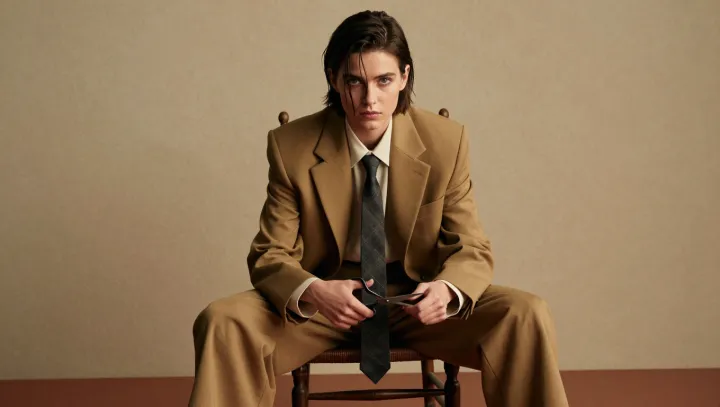
Sepia is the shortcut. A loose khaki suit acquires a more persuasive vintage character when light crosses its surface from one side, revealing the cloth and construction that a brown tint merely recolors. Texture does the work. Where frontal illumination can soften differences between folds, directional light gives the lapel, sleeve and trouser crease their own readable edges.
Looseness needs some discipline. With a broad window beside the suit rather than behind the camera, highlights settle on raised folds while shadows describe the space beneath them, making generous proportions easier to read. Consider the lapel roll. Its curved transition from chest to collar becomes more apparent under oblique illumination, while a twill weave, if present, can register as diagonal ribs rather than an undifferentiated beige surface. Darkness needs restraint, too. A white board opposite the window can return enough light to preserve shadow detail without erasing the contrast that gives the jacket its shape.
Color should stay honest. Keeping the white balance close to neutral lets khaki retain its particular mixture of brown, yellow or green, instead of forcing every surface into the same nostalgic cast. Refinement is not distress. Deep shadows and aggressive contrast can exaggerate wrinkles, so a sheer curtain or a larger light source often serves the cloth better than a small, bare lamp. Leave the filter alone. In the finished frame, the suit should seem to have kept its years in the turn of a sleeve, not borrowed them from a bottle of brown.