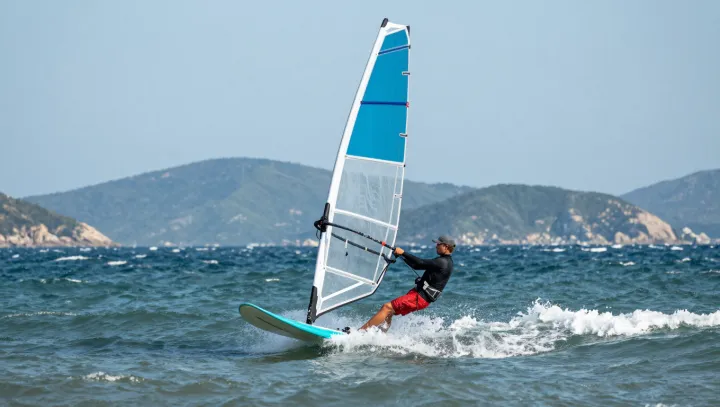
Headwinds need not win. Although a sailboat cannot sail straight into the wind, it can approach an upwind destination by alternating between diagonal courses, extracting forward motion from forces that seem destined to push it backward. The detour delivers progress. Called tacking, this zigzag makes the boat's apparent refusal to follow a straight line the very condition of its advance.
The sail deserves less credit. Rather than acting alone as a sheet that catches a shove, a trimmed sail behaves as an airfoil, generating aerodynamic lift as airflow changes direction and pressure differs across its surfaces. That force points partly sideways. Because the sail meets apparent wind, the airflow experienced aboard a moving boat, its useful orientation depends on both the surrounding wind and the vessel's own motion through it. Lift is not free. Drag accompanies it, and pointing too close to the wind leaves the sail unable to sustain useful drive.
The keel earns its keep. As the hull moves through water, the keel generates hydrodynamic lift that opposes much of the sail's sideways force, limiting the lateral drift sailors call leeway while leaving a forward force to overcome resistance. Some sideways slip remains. By turning the bow through the wind, the boat changes tack, exchanging one diagonal heading for another while continuing to gain ground toward its destination. Shortest is not fastest. Between the two headings lies a direction the boat cannot sail, yet across the water its wake draws a route toward precisely that forbidden point.