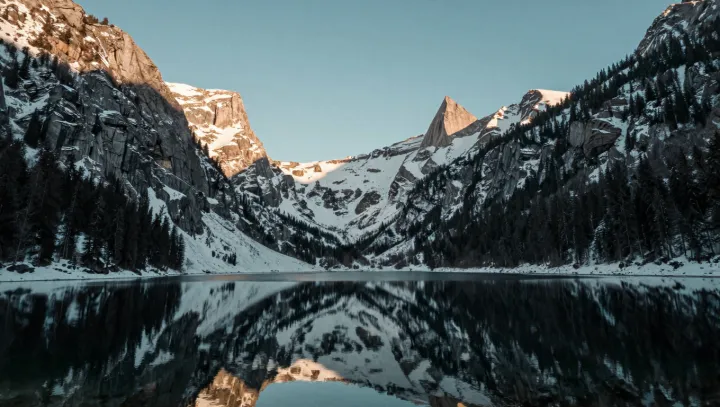
Clarity gets too much credit. A lake can carry sediment beneath its surface and still return a sharp image of trees or clouds, provided that wind has left the water undisturbed. Stillness does the work. What matters first is the boundary between air and water, where light changes direction before entering the lake.
Ripples are the real spoilers. Under specular reflection, incoming light leaves a smooth surface at an angle equal to its arrival angle, allowing neighboring points to preserve a recognizable image. Waves break that agreement. Each tilted patch sends light toward a different direction, stretching a tree into streaks or scattering its outline across the water. Brightness deserves equal billing. Sunlit clouds above shaded water can produce a strong reflection because their returning light outweighs light arriving from beneath the surface. Transparency can even compete. A visible lakebed may distract from the reflected scene rather than improve it.
Position beats purity, too. The Fresnel equations describe how the reflected share of light increases toward grazing angles, making a low sightline across water more favorable than looking straight down. Low is not magic. The chosen position must also place a bright subject in the reflected view, while shelter from wind helps preserve its shape. Clear water offers no guarantee. A transparent lake under a breeze can lose its mirror image, while darker water in a sheltered inlet may hold one cleanly. The distinction is almost mischievous. A lake reveals the world above most faithfully when its own depths withdraw from view.