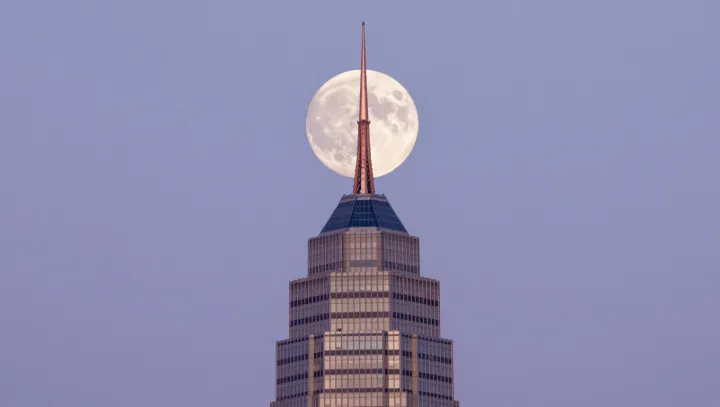
Height buys no moonlight. On an unobstructed street, sunlight reflected from the Moon already reaches exposed skin after crossing space for roughly 1.3 seconds, making the skyscraper less an instrument of discovery than an expensive change of viewpoint. The pavement qualifies already. What looks like a prize reserved for the rooftop is available beside the curb.
The romance survives correction. Moonlight consists of photons scattered by the lunar surface, whose low albedo means that most incoming sunlight is absorbed rather than returned to space. Reflection does the work. At the Moon's average distance of about 384,400 kilometers, light traveling at approximately 299,792 kilometers per second takes about 1.28 seconds to reach Earth, with the exact interval varying as the distance changes. That excludes the opening leg. Before striking the Moon, the sunlight has already spent roughly eight minutes traveling from the Sun, so the familiar 1.3-second figure describes only the final crossing.
Altitude sells a distinction. A rooftop can clear neighboring buildings and widen the visible sky, but where both street and roof have an unobstructed view of the Moon, climbing does not confer a special category of illumination. Nor does closeness matter much. Even a kilometer gained directly toward the Moon would shorten the light's journey by only about three millionths of a second, without making its touch meaningfully different. The attraction lies elsewhere. Above the traffic, the city may look briefly manageable; below, on an unremarkable stretch of pavement, the same borrowed light rests on an upturned hand.