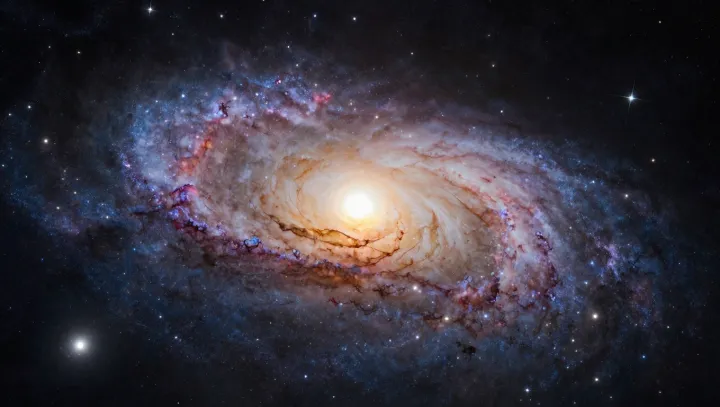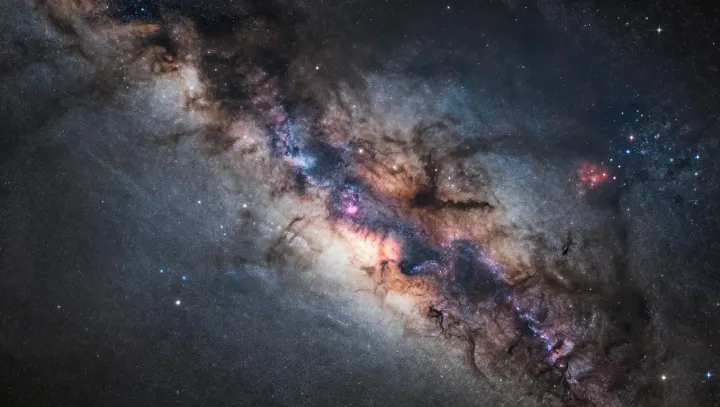
Darkness is misleading here. The band cutting across Centaurus A looks empty because interstellar dust absorbs and scatters visible light, hiding stars behind and within a disk rich in gas. Obscurity is not absence. Seen against the galaxy's bright stellar body, that dusty material produces a silhouette, although it contains the raw ingredients from which stars form.
The cold favors birth. Inside molecular clouds, shielding from ultraviolet radiation allows gas to remain relatively cool, reducing the thermal pressure that would otherwise resist gravity as denser pockets gather more material. Gravity can then win. Where support from pressure, turbulence and magnetic fields proves insufficient, gravitational collapse produces contracting cores that can develop into protostars, with surrounding gas continuing to feed their growth. Dust assists the process. Besides blocking starlight, grains provide surfaces on which hydrogen molecules form, while radiation from gas and dust helps clouds lose heat during parts of their contraction.
Visible light undersells this galaxy. Infrared observations penetrate much of the obscuration and detect embedded stars and heated dust, while radio measurements trace molecular gas through emission from molecules such as carbon monoxide. The merger connection matters. Centaurus A's distorted, dusty disk is widely understood as material acquired through a galactic merger, which supplied gas and disturbed its motions, encouraging compression in some regions rather than leaving a vacant stripe. The darkness keeps its secret. Against the surrounding glow, the material that hides young stars draws the sharpest line.