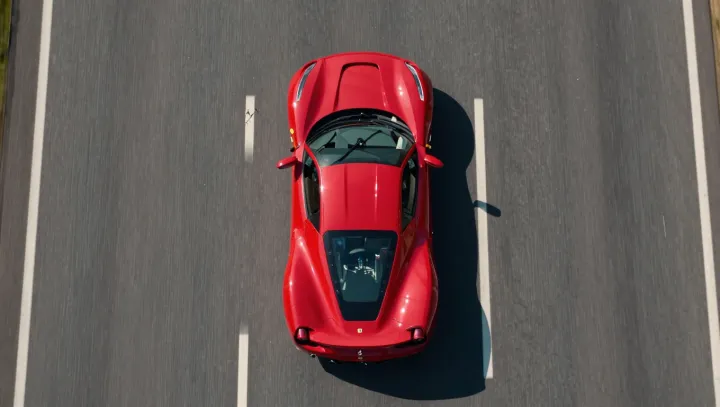
A steady engine is no guarantee of economical driving. Speed has its price. Even when a Ferrari cruises without changing pace, the air resists its passage; as speed rises, overcoming that resistance demands more power and generally more fuel for every mile traveled.
The chief opponent is aerodynamic drag, not an unsteady throttle. Drag rises roughly with the square of speed, while the power needed to overcome it rises roughly with the cube. Faster is rarely free. At twice the speed, a car faces roughly four times the aerodynamic drag and needs roughly eight times the power to push through the air, assuming comparable conditions. Fuel use per mile does not necessarily rise by the same factor, because engines operate at different efficiencies and other forces also matter.
Restraint at the pedal remains a sensible bargain, though it cannot repeal physics. Accelerating smoothly can avoid needless bursts of power, and leaving space ahead reduces the need for repeated braking and acceleration. Anticipation saves momentum. Tire pressure, road gradient, traffic and the car's chosen gear also affect consumption, so no single technique guarantees a particular saving. Driving at a moderate, legal speed can reduce the aerodynamic burden; maintaining that speed where conditions permit avoids some wasteful changes in pace. The Ferrari still cuts through the air, but the air always sends a bill.