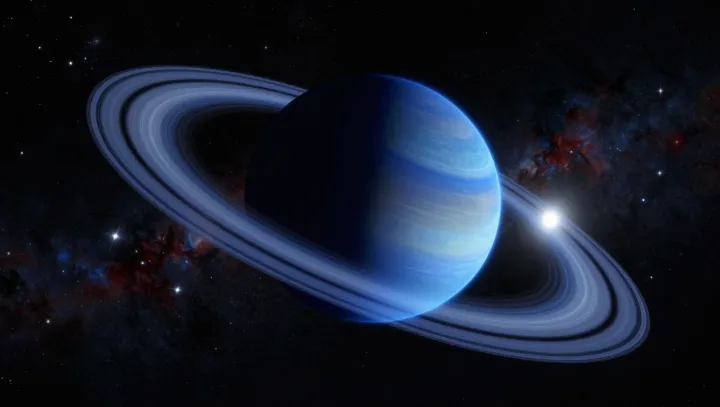
Saturn's rings are less a solid spectacle than a vast exercise in restraint. Spread across hundreds of thousands of kilometers, their main bands are astonishingly thin by comparison, with much of their material confined to a layer roughly tens of meters thick. Ice and rock orbit separately, not as parts of a single disk.
The flatness is hard won. Ring particles travel around Saturn at different speeds, repeatedly colliding as their paths cross. These collisions dissipate energy from motion that carries particles above and below the orbital plane, gradually settling the swarm into a thin sheet. Yet the sheet is not perfectly smooth: the particles' own gravity can gather them into temporary structures, and interactions with nearby moons can raise waves and distort the rings. Order, here, is never quite still.
Making a moon is harder still. Within much of the ring system, Saturn's tidal forces pull more strongly on the near side of a loose collection of particles than on its far side. Inside the Roche limit, that difference can tear apart an object held together chiefly by its own gravity. Orbital shear adds another obstacle: neighboring particles circle at different speeds, pulling temporary gatherings apart. Small clumps can still form, and stronger objects can survive; near the rings' outer edges, material may even accumulate into small moons. An illustrated blue planet can capture the shape, but the real ring's beauty lies in a balance that never holds perfectly still.