The denim jacket owes its staying power to a useful contradiction: it lends order to an outfit without making it look formal. Its firm shoulders and straight seams give the eye a frame, while softer layers can move around it. The effect feels effortless. It is also carefully balanced.
Workwear gave the jacket its authority long before casual dress made it commonplace. Denim, a sturdy cotton twill, was suited to hard use, and early jackets offered workers practical pockets and a durable outer layer. Its appeal spread beyond the workplace. Film and youth culture helped recast the garment as a sign of independence; later, designers and wearers adopted it for everyday dress, often keeping the recognizable seams and metal buttons. What began as protection became a kind of visual shorthand: relaxed, familiar and just structured enough.
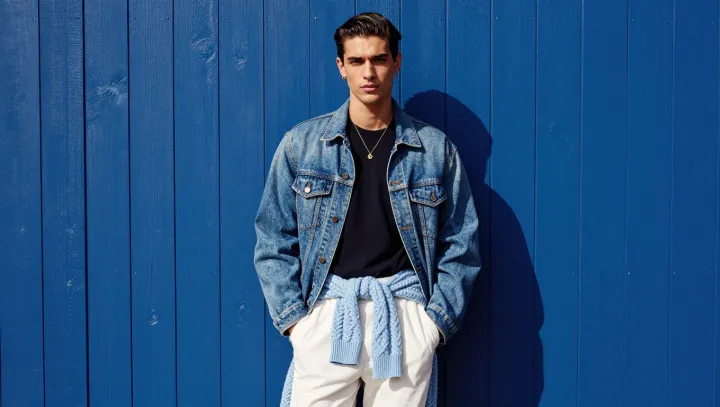
That structure is most persuasive when it has something softer to push against. Here, a blue denim jacket sits over a black top, creating a dark center that makes the jacket's outline easy to read. A pale blue sweater tied at the waist introduces a lighter tone and a looser shape; its knit texture contrasts with the denim's tightly woven surface. The proportions matter too. The jacket holds the upper body in a defined silhouette, while the sweater's drape interrupts any stiffness below. In that small exchange between cloth and shape, workwear finds room to rest.