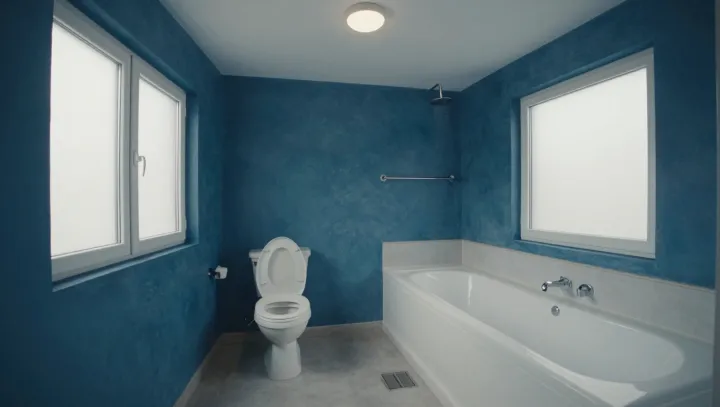
A small bathroom need not retreat into white. Here, textured blue walls give the eye more to explore, while white fixtures stand apart against the darker surface and frosted windows soften incoming daylight. The room gains visual depth, not floor area. Its apparent size depends on how those surfaces meet the light.
Texture is most persuasive when light reveals rather than flattens it. Light striking a wall at a shallow angle, known as grazing incidence, casts small shadows across its raised areas; from farther back, those variations can make the surface feel less like a blank boundary. Too much grazing light, though, may exaggerate unevenness. Light aimed more directly at the wall reduces those shadows, producing a calmer but flatter effect. Frosted glass adds another variable: it scatters transmitted daylight, softening sharp contrasts while still admitting light.
White fixtures do more than provide contrast. Their higher light reflectance value generally means they return more visible light than a darker blue surface, giving the eye bright reference points without requiring every wall to be pale. Color alone cannot guarantee spaciousness: a deep blue may absorb enough light to make the room feel more enclosed, especially where daylight is limited. Test the finish in the actual room, under both window light and the intended fixtures. A wall can be blue in every light and yet never quite the same wall.