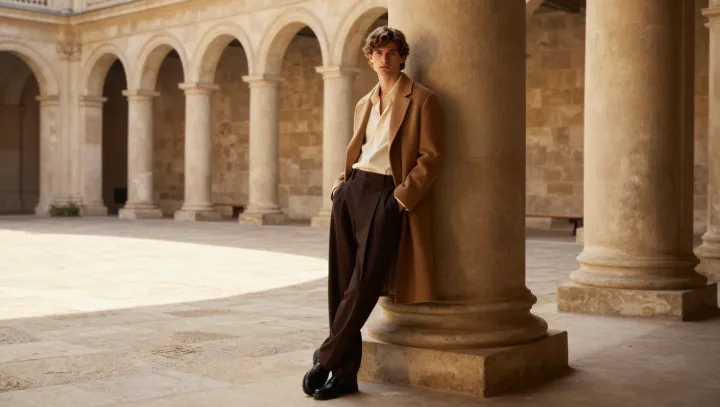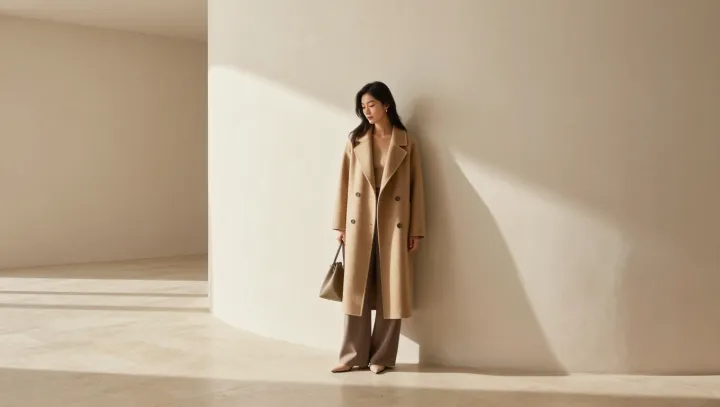
A long camel coat and taupe wide-leg trousers can look leaner together than a collection of fitted separates. The effect is not magic. When neighboring colors flow into one another and generous pieces fall in clean lines, the eye meets fewer abrupt stops between shoulder and shoe.
Proportion, not tightness, does the work. A coat with defined shoulders gives the upper body a frame, while trousers that hang from the waist rather than cling to the legs carry a vertical line downward. In tailoring, drape matters: fabric with enough weight to fall smoothly can keep width from looking shapeless. Hem length matters too. Trousers that skim the shoe preserve that line; fabric pooling heavily around the ankle can interrupt it. A pointed toe, visible beneath the hem, extends the shape without requiring a high heel.
Contrast is most persuasive when it is measured. Camel and taupe sit close enough in value to connect the coat and trousers, yet their slight difference lets each piece retain its shape. A dark belt or a sharply contrasting top can draw attention to the waist, but it may also divide the outfit into separate blocks. Fit still has its place. A neater layer under the coat can keep the torso from feeling engulfed, especially when the outer fabric is substantial. Fitted separates, by contrast, can emphasize every change in contour without producing a continuous line. Beneath the long coat, the pointed shoe offers a quiet vanishing point.