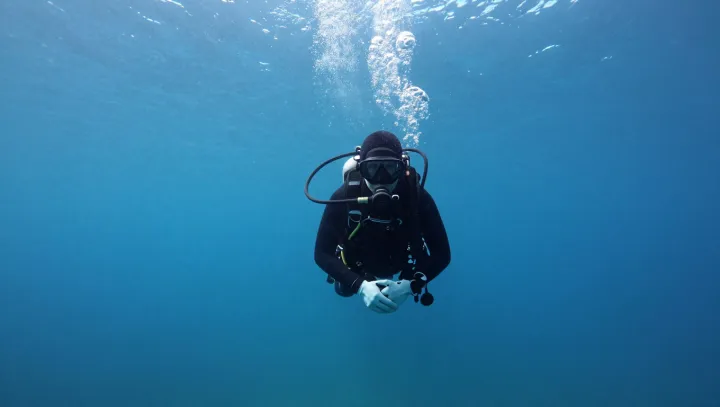
Depth makes every breath more expensive. The deeper a diver goes, the more water presses on the body, and the more densely packed the air in each lungful must be. Breathing at the same pace does not keep tank consumption constant. Pressure changes the arithmetic.
The regulator solves one problem while creating another. It reduces the tank's compressed air pressure in stages, delivering air at the surrounding ambient pressure so the lungs can expand against the water's squeeze. At roughly ten meters in seawater, ambient pressure is about twice the pressure at the surface. By Boyle's law, a given volume of air at that depth contains roughly twice as much gas as the same volume at the surface, assuming temperature is constant. Each breath takes more.
The practical consequence is a shorter supply, not necessarily a faster heartbeat. If breathing rate and the volume of each breath remain unchanged, a tank that would supply a given number of minutes at the surface will supply roughly half as many at ten meters. At twenty meters, where pressure is about three times the surface value, the theoretical supply falls to about a third. Real consumption also varies with exertion, stress and equipment. Watch the pressure gauge. Depth may be invisible in a single breath, but its cost accumulates with every one.