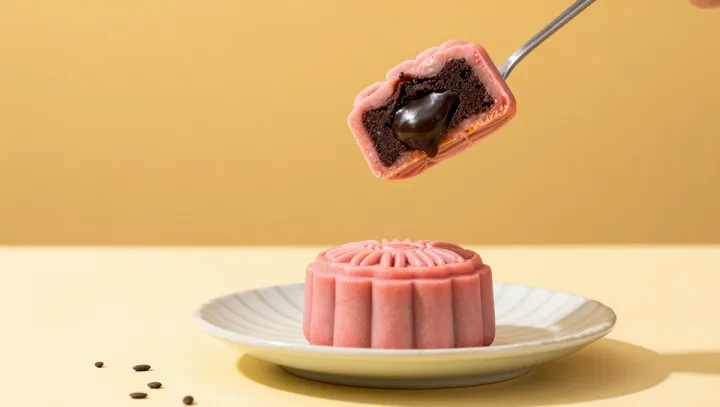
The pink crust makes an unlikely promise: elaborate patterns without an oven. Pressed into a mold around a dark filling, the pastry holds fine ridges and curves while remaining soft to the bite. Its finish is no mere decoration. The preparation of the dough determines whether those details survive.
The secret is cooked starch, not raw flour. When glutinous rice flour is heated with liquid, its starch granules absorb water and swell, a process called gelatinization. The flour contains a high proportion of amylopectin, a branched starch that helps give the cooled dough its characteristic chew. No oven is needed. The flour mixture is typically steamed or otherwise cooked before it is wrapped around the filling and pressed into shape; the finished pastry is not baked. Despite its name, glutinous rice does not contain gluten.
Cold brings its own compromise. Chilling helps a soft molded pastry keep its form, but starch molecules gradually rearrange during storage, a process known as retrogradation that can make the crust firmer. Recipes differ in their proportions of flour, water, sugar and fat, so texture and storage life vary too. Perishable fillings call for refrigeration, and the maker's storage instructions matter. The dark center may be a sweet bean paste or another filling, while coloring can give the crust its pink shade. Beneath each impression in the mold lies a negotiation between a shape meant to last and a softness meant to yield.