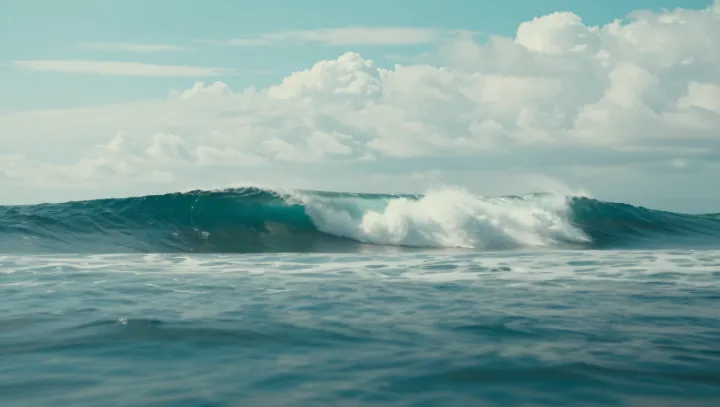
A glassy sea surface is never truly still. Tiny ripples scroll across the water, carrying information about distant winds, migrating tides and the combined gravity of the Moon and Sun. Each crest and trough encodes energy injected into the ocean far away, then redistributed across the surface through wave propagation.
Physicists describe this restless pattern using wave mechanics and fluid dynamics. Local capillary waves, driven by surface tension, ride on top of longer gravity waves shaped by larger pressure gradients and tidal forcing. The same gravitational field that governs orbital mechanics and controls tidal range also modulates the sea’s surface elevation by small but measurable amounts.
Satellite altimetry and coastal wave buoys track these fluctuations, turning the ocean into a global sensor array. Subtle changes in wave period, amplitude and direction reveal shifts in atmospheric pressure, remote storm systems and large-scale tidal currents. Even on days that feel calm to an observer on deck, the surface ripples quietly log the continuous negotiation between wind, water and celestial gravity.