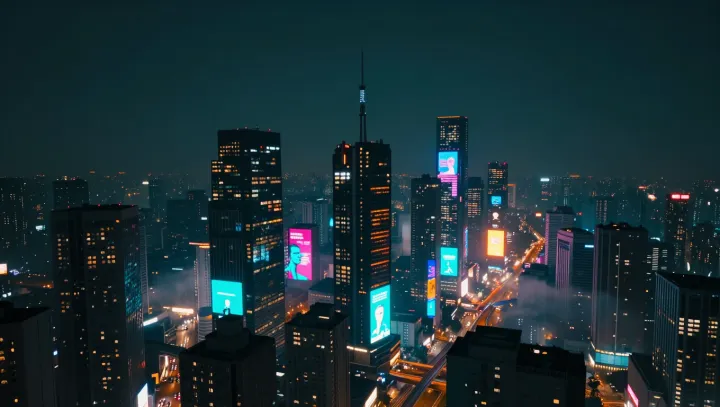
A broken game engine, flickering textures and bug-filled missions ended up mapping one of the clearest blueprints for life inside networked cities. What began as a punchline now functions as a playable philosophy lab for surveillance, corporate power and synthetic bodies.
The world on screen stitches ad-saturated streets, biometric checkpoints and data-mined nightlife into a continuous feedback loop, where every movement is logged, priced and resold. Instead of a clean dystopia, the game shows governance as a messy equilibrium of platform monopolies, private security and gig workers, all optimizing their own marginal utility curves. Underneath the combat and quests runs an implicit lesson in information asymmetry: the entity that owns the sensors owns the narrative, and therefore the market.
Body modification, framed as character progression, quietly rehearses debates about cognitive enhancement and cybernetic implants. Skill trees resemble a behavioral economics dashboard, exposing trade-offs between risk, processing load and social visibility. The universe treats the human body less as a sanctuary and more as an interface, where cartilage, silicone and firmware share the same cost-benefit calculus. In forcing players to tweak their own ‘baseline metabolism’ of attention, stamina and memory, the game turns optimization into an existential question rather than a mere power-up.
Even the glitches serve the thought experiment: geometry tearing and AI pathfinding failures feel like visualizations of entropy, moments when a tightly coupled surveillance stack briefly loses coherence. In those fractures, the design hints at a deeper tension between control and decay, suggesting that any fully instrumented city will always live on the edge of both omniscience and collapse.