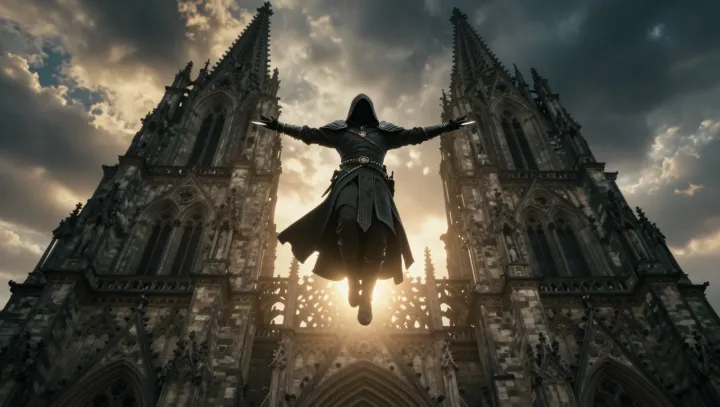
A video game franchise built around rooftop assassins ended up rewriting the first point of contact with history for an entire generation. Assassin’s Creed, conceived as stealth entertainment, has become a de facto survey course in past civilizations, from city layouts to political factions, delivered through a controller instead of a textbook.
The shift was not an accident so much as an emergent property of production scale. Ubisoft poured resources into historical research, hiring consultants, mining archives and integrating primary sources into level design. What began as background texture became curriculum: game worlds simulate social hierarchies, urban morphology and religious power structures, giving players a kind of informal basic literacy in historiography. The feedback loop is classic marginal effect: curiosity sparked by spectacle drives players toward documentaries, museum visits and further reading, extending the franchise’s footprint far beyond the screen.
Educators then treated the series as an entry valve rather than an enemy, using screenshots, map layouts and plotlines as scaffolding to discuss historical bias, anachronism and narrative entropy in collective memory. The games do not replace scholarship, but they set the default mental wallpaper: when many people picture certain eras, they now see digital domes, plazas and skylines first. In that sense a commercial blockbuster, tuned for combat and parkour, has quietly become one of the most influential gatekeepers of the past.