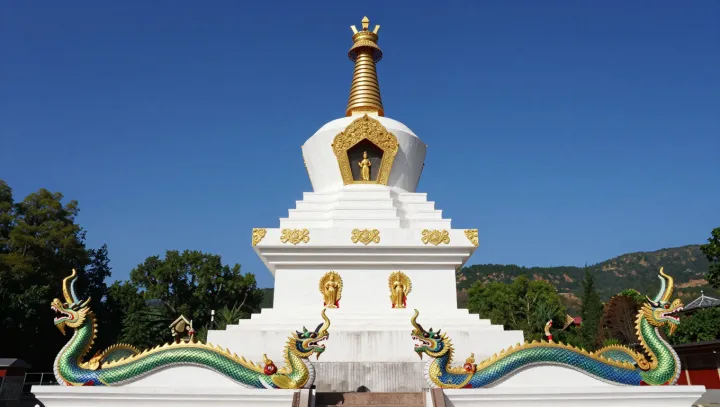
Wat Chalong does not simply display Buddhist art; it stages a full sensory intervention on stress. Long axial walkways slow gait and breathing, while tightly controlled sightlines push attention toward central shrines and away from visual clutter. This combination shapes autonomic nervous system activity long before any formal act of worship begins.
Studies on heart rate variability and cortisol show that enclosed spaces with clear spatial hierarchy and predictable symmetry tend to lower physiological arousal. Wat Chalong mirrors that template. High ceilings and stepped roofs create a pressure gradient that channels hot air upward, stabilizing perceived thermal load. Narrow doorways then compress visitors into cooler, darker interiors where luminance contrast hovers in a range known to reduce pupillary strain.
Filtered daylight, entering through clerestory windows and small apertures, lands on gilded murals and layered iconography, creating a slow-reading visual field that reduces sensory entropy instead of flooding the retina. Sound operates as a second system. Low-frequency drumbeats and bell tones, with long reverberation time in the main hall, entrain breathing toward slower cycles and nudge the parasympathetic branch of the nervous system.
Incense, chanting, and the soft shuffle of bare feet form a stable acoustic backdrop that masks sudden spikes in ambient noise. That stable signal lowers amygdala reactivity, according to environmental psychology research on soundscapes. Within that controlled envelope of light and sound, the intricate art ceases to be mere decoration and becomes a calibrated interface between doctrine and physiology.