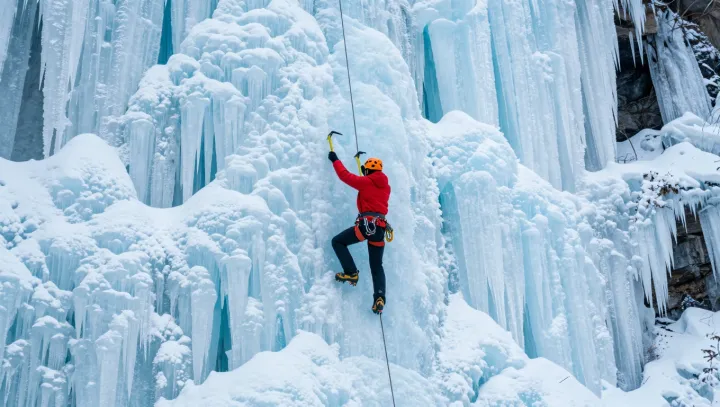
A frozen waterfall behaves less like a smooth sheet of glass and more like a constantly rewired lattice of crystals. As liquid water cools and solidifies, it undergoes a phase transition that locks molecules into a hexagonal pattern, but not in a uniform way. Flow, spray and trapped air create layers, bubbles and stresses that build a vertical structure riddled with invisible weak planes.
When an ice axe strikes that wall, the impact loads a tiny region with high stress, triggering classic fracture mechanics. Stress waves race through the crystal network, searching for existing micro‑cracks and grain boundaries that act as pre‑made fault lines. If the axe sits over compressed, bonded grains, the force disperses and the pick holds. If it lands near a thin, sun‑softened layer or a column of brittle, aerated ice, the same force can propagate a crack and shear a whole section away.
Temperature gradients, creep deformation and repeated blows constantly edit this vertical “rock” in real time. Slight warming increases molecular motion, reduces strength and changes how energy dissipates, turning solid‑feeling ice into something closer to stacked plates. Each swing is an experiment in local tensile strength and shear resistance, decided in the fraction of a heartbeat between impact and commitment.