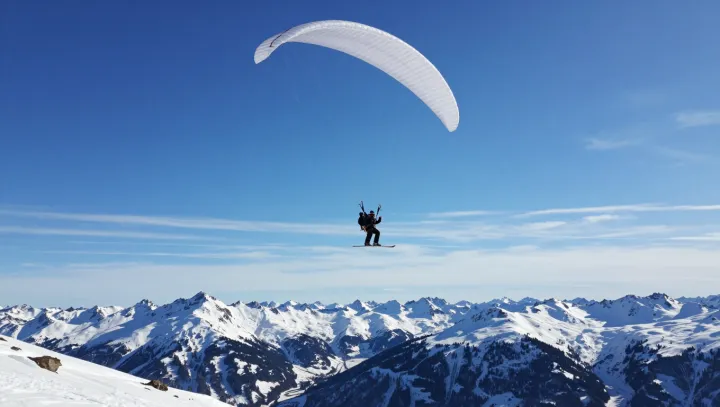
Air pressure hits fabric and bone before any scream reaches the valley floor. In that window of falling distance, physics is not a classroom abstraction but the only interface between a human body and rock. Glide ratio, wind vectors and impact time are not guessed; they are already embedded in the jump plan long before the cliff edge appears.
Elite wingsuit BASE jumpers do not solve fresh equations in freefall so much as execute precompiled code. During meticulous preparation, they model lift, drag and terminal velocity, compare wingsuit surface area to body mass, and run conservative scenarios for shifting wind shear. That explicit work recruits the prefrontal cortex, but repetition migrates key patterns into procedural memory and the basal ganglia, reducing cognitive load when the suit inflates and noise rises.
Once in flight, sensory input floods fast: optic flow across rock faces, barometric changes against the face, micro-turbulence on forearms. The brain converts that stream into a kind of real-time Bayesian update, constantly refining estimates of glide path and time-to-impact. Heart rate and cortisol spike, yet trained breath control and habituation dampen amygdala overreaction, protecting working memory and visuospatial processing. Instead of verbal math, jumpers rely on calibrated heuristics: this angle over this ridge equals this escape line; this sound of flapping means too close to stall speed.
Neuroscientists describe this as a shift in arousal along the Yerkes-Dodson curve toward an efficient band where reaction time, motor control and situational awareness are maximized. Years of deliberate practice prune synapses, lowering neural noise and raising the signal-to-noise ratio for threat cues. The apparent calm is not absence of fear but a trained ability to let autonomic responses handle most of the physics, while conscious attention reserves are kept for anomalies: a sudden rotor of air, an off-course trajectory, the one deviation that turns a calculated risk into a fatal miscalculation.