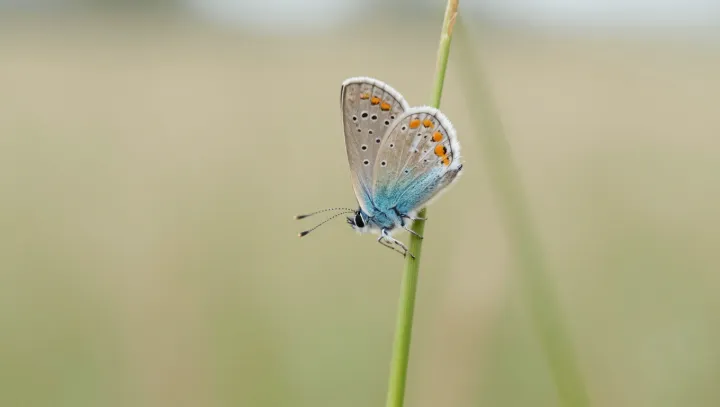
A blue morpho butterfly wing acts less like paint and more like an optical device. Under white light, the surface turns into a selective filter that throws back a narrow slice of the spectrum as a saturated blue, even though the scales contain almost no blue pigment at all.
The effect comes from structural color, driven by precise nanostructures in the wing scales. Ridges and layers form a biological photonic crystal that manipulates the propagation of light waves. When incident white light hits these repeating structures, constructive interference amplifies blue wavelengths while destructive interference cancels many others. Because photons are not simply absorbed but redirected, the apparent brightness can exceed that of many blue LEDs at comparable viewing conditions, despite no chemical chromophore doing the work.
The architecture resembles a stack of engineered dielectric mirrors, only grown by cells through biochemical self‑assembly. Variations in refractive index and layer thickness tune the local band gap for light, much as electronic band structure governs electron flow in a semiconductor. Multiple scattering between ridges further boosts directional reflectance, giving the wings their vivid flash from certain angles and a more diffuse glow from others. For researchers in nanophotonics and biomimicry, the blue morpho offers a living manual on how to turn geometry, not pigment, into extreme optical performance.