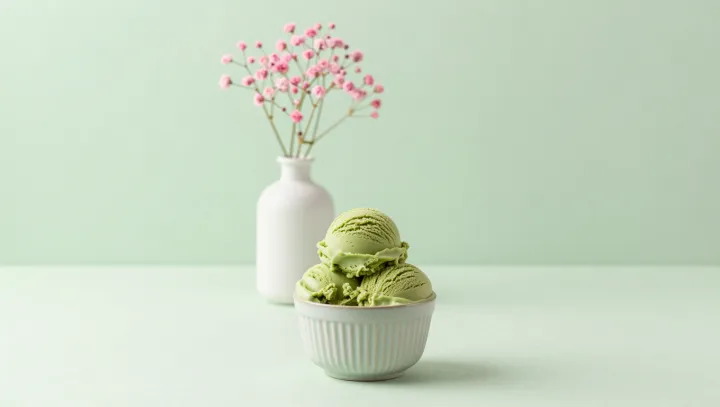
A single teaspoon of matcha behaves like three different ingredients, depending on how its flavor molecules are mixed, heated, and trapped. In a chewy ice-cream swirl, matcha is dispersed inside an emulsion of milk fat and water. As the mix churns and freezes, tiny ice crystals form while fat droplets and milk proteins build a soft, elastic network that slows diffusion of aroma compounds and caffeine, giving a dense, stretchy spoonful instead of a brittle ice block.
Inside a molten lava cake, the same powder rides a different structure. Wheat gluten and egg proteins denature and coagulate at high temperature, forming a semi-solid shell, while the starch gelatinization inside lags behind. The center stays fluid because its water-rich phase never fully sets, so matcha remains in a hot, flowing suspension that bursts out as soon as the outer protein matrix cracks.
In a no-bake cheesecake layer, heat steps aside and food colloids take over. Cream cheese and whipped cream create a fat-protein mesh, while gelatin or agar form a hydrogel that immobilizes water. Matcha particles and their volatile compounds are locked into this cold gel matrix, which resists gravity without an oven. One teaspoon, three architectures, all driven by the same underlying thermodynamics of water, fat, and proteins.