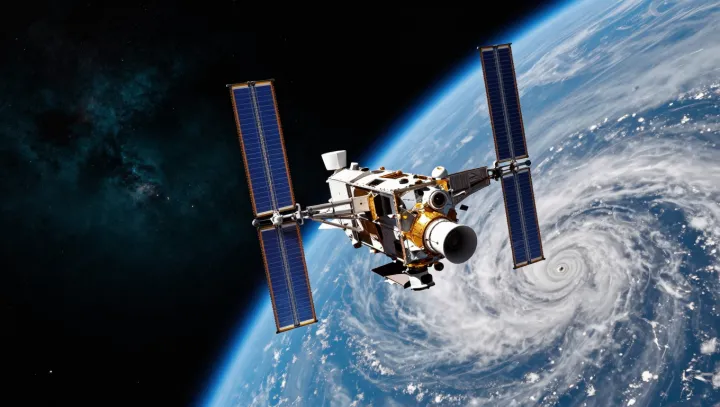
The International Space Station stays in orbit because it is always falling toward Earth and always missing it. Gravity at that altitude is only slightly weaker than on the ground, so the station and everything inside it accelerate downward together. This shared acceleration cancels the normal sensation of weight that people associate with standing on a floor.
In orbital mechanics terms, the station’s horizontal velocity continuously bends its path around the planet, creating a stable free fall known as a gravitational orbit. Astronauts float because no solid surface pushes back on their bodies to create a contact force, the key ingredient of apparent weight. Their bones, fluids and inner ear still experience gravitational acceleration, but without a supporting floor they feel suspended, like in an elevator whose cables have just snapped.
Engineers describe this environment as microgravity rather than zero gravity, since small residual forces remain. Atmospheric drag, slight vibrations and tiny variations in Earth’s gravitational field all produce minute accelerations. These effects are enough to nudge experiments in fluid dynamics and protein crystallization, yet too small to restore any clear sense of up or down for the crew.