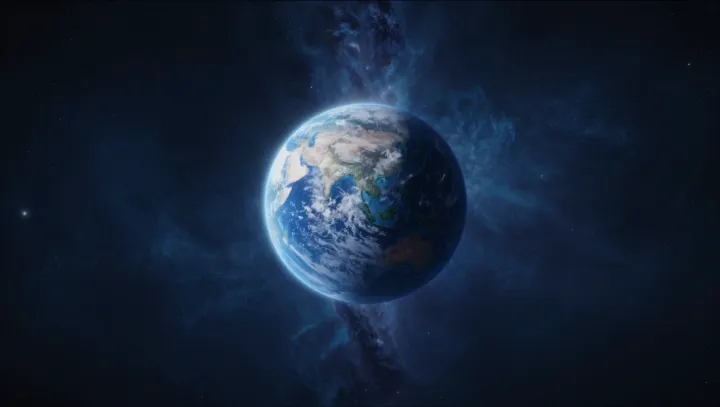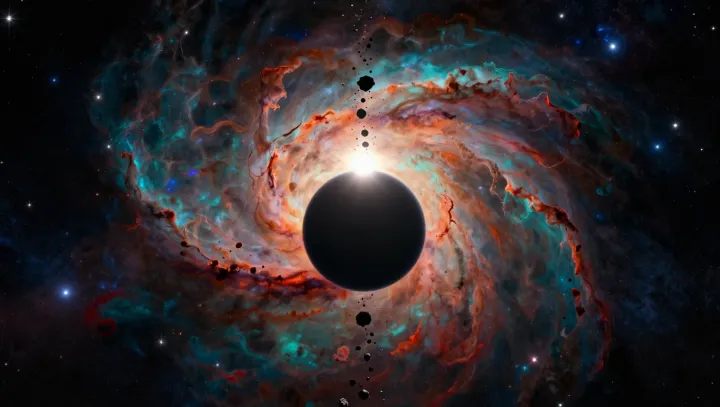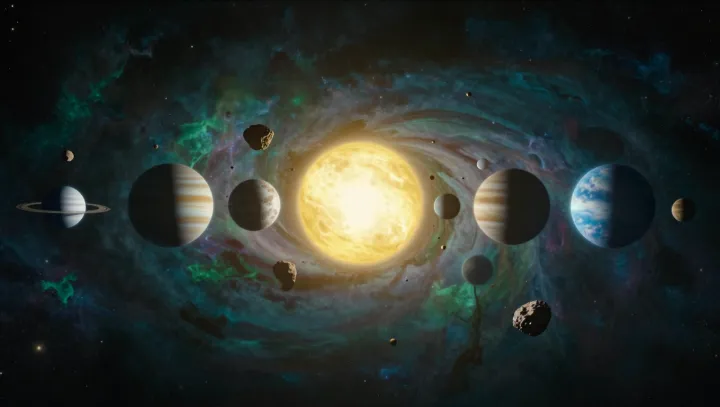
Darkness hides most planets in the universe long before any telescope has a chance to find them. Planetary bodies are small, cold and faint compared with stars, so their own thermal radiation and reflected light drop below detection limits at vast distances.
Observations already show that exoplanets are common, and gravitational microlensing hints at free floating planets that have no host star at all. Without stellar light to reflect, these rogue objects radiate only weak infrared emission set by blackbody radiation and basic thermodynamics, making them effectively black against the cosmic background for current instruments.
Even planets bound to stars usually orbit in planes and at separations that keep them lost in glare. Stellar luminosity overwhelms the tiny flux from a planet, while interstellar dust, limited angular resolution and signal to noise thresholds erase most candidates from surveys. Detection methods such as the transit technique and radial velocity depend on specific orbital alignments and measurable Doppler shifts, so they only sample a thin, biased fraction of existing worlds.
Selection effects, observational entropy and finite telescope sensitivity combine to ensure that the known catalog represents a narrow surface of a much larger planetary population, most of it silent and unseen.