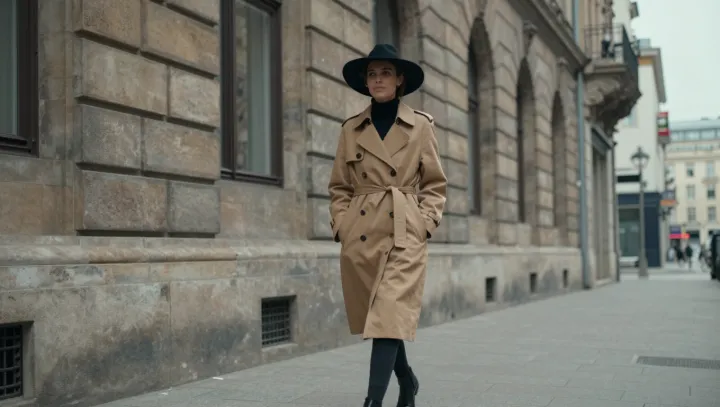
Soft, slightly dusty coat colors can make a face look younger than pure black, even when black visually narrows the body. The reason sits in how the eye reads contrast, not just contour. High-contrast edges around the neck and jaw exaggerate micro shadows, which the brain often codes as age signals rather than elegance alone.
Black creates a sharp luminance jump next to most skin tones, boosting the visibility of nasolabial folds and periorbital shadows through simple light-scattering and edge-detection in the visual cortex. Muted camel or blue sit closer to average skin brightness and chroma, so they soften boundary lines and reduce the perceived depth of wrinkles and eye bags without changing the actual facial anatomy.
Color scientists would frame this as a trade-off between the slimming marginal effect of dark value and the aging effect of extreme contrast. When the value gap between coat and skin shrinks, local contrast around texture drops, so fine lines and uneven pigmentation trigger fewer aging cues. In practice, a slightly grayed camel or blue still shapes the silhouette, but it keeps the spotlight on the face rather than on every tiny shadow it casts.