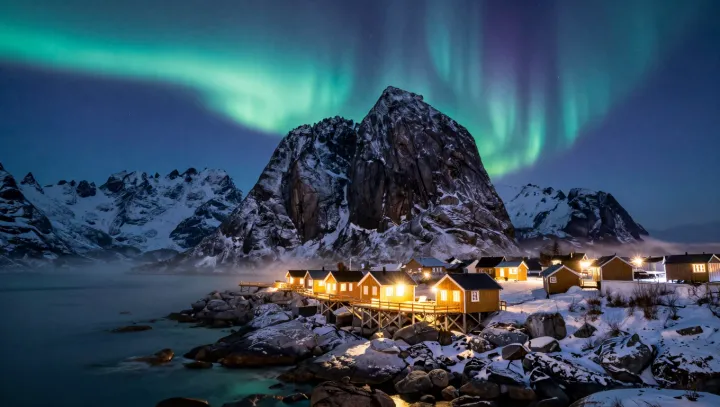
Darkness arrives and simply stays. In one Norwegian town, the sun sinks below the horizon and does not return for many cycles of sleep and work, yet streets, schools and offices continue to move to a rhythm that still feels like day and night.
The town’s survival strategy is less about stoic endurance and more about careful engineering of time. Bright, blue‑enriched artificial light is used in homes, schools and public buildings to nudge the suprachiasmatic nucleus, the brain’s master clock, mimicking the spectral quality of daylight just after waking hours. That lighting schedule, combined with regular meal times and consistent sleep windows, anchors the circadian rhythm even when natural sunrise is missing. As melatonin secretion would otherwise drift, clinicians and researchers treat light exposure almost like a drug: dose, timing and intensity all matter.
Urban design and culture do the rest. Outdoor areas are lit not for romance but for lux levels, so people keep walking, commuting and exercising instead of retreating indoors. Workplaces protect predictable start times and breaks, reinforcing social zeitgebers, the cues that tell the body what time it is. Community events, from sports to music, cluster in the same evening slots, building a shared schedule that resists entropy in daily life. In this prolonged night, the town turns light, routine and human contact into a quiet infrastructure for mental stability.
When the first thin band of twilight finally returns, it meets a community that has not waited in suspension, but has kept its internal clocks ticking in the dark.