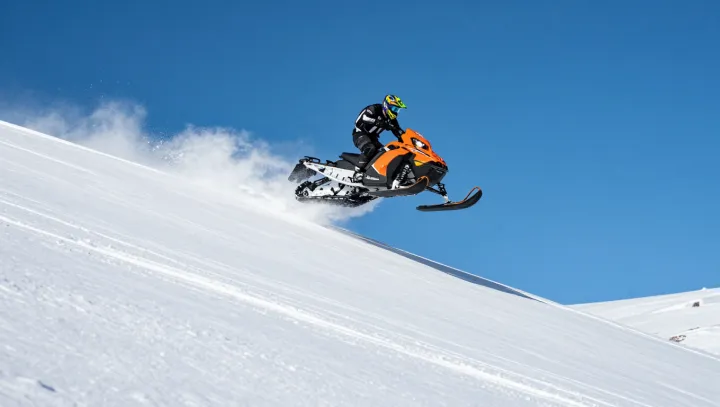
Deep powder allows a heavy snowmobile to skim across its surface while a nearby person can sink in almost to the hips. The contrast is not about total weight but about how that weight interacts with the snowpack through contact area and pressure.
The snowmobile uses a long track and wide skis that distribute its mass over a large footprint. This lowers the normal stress on the snow to a level below the snow’s compressive strength. The snow crystals form a load‑bearing network, similar to a granular material in soil mechanics, so the machine effectively “floats” on a semi‑solid layer instead of cutting straight through it.
A person standing beside the machine loads the snow in a completely different way. Body weight is focused onto two small boot soles, creating a much higher ground pressure. That pressure exceeds the yield strength of the loose powder, causing local failure and rapid compaction. As the snow collapses and densifies under each step, the feet sink deeper until the effective contact area grows enough for the forces to balance. The scene looks paradoxical, but it is simply Archimedes and contact mechanics at work in a winter field.