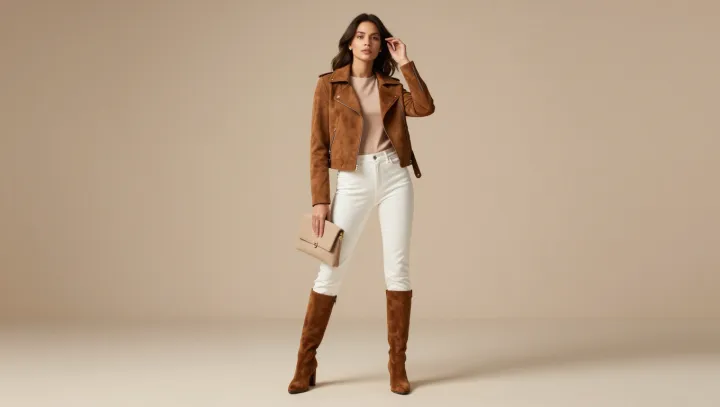
A warm coffee palette does something bolder shades rarely manage: it flatters almost everyone while looking discreetly expensive. Soft latte, caramel, and espresso tones sit in the warm segment of the Munsell color system, which means their dominant wavelength aligns with the reddish‑yellow bias in human skin. Because of this spectral proximity, the boundary between fabric and skin shows low chromatic conflict, so minor redness, sallowness, or uneven patches visually recede instead of being highlighted.
The real trick is contrast, not drama. When warm neutrals are slightly darker or lighter than your skin on the CIE L*a*b* scale, they create gentle luminance contrast that makes the face appear brighter without needing high saturation. This is the same principle television calibrators use with gamma and mid‑tone compression to keep faces luminous against neutral backdrops. Add to that the low gloss of matte or brushed textures, which scatter incident light through diffuse reflection, and you avoid harsh specular hotspots that can exaggerate pores or fine lines while still catching enough glow to suggest quality.
Luxury, in visual psychology, often reads as control rather than noise. Because a single warm coffee range keeps hue variation narrow, it creates what designers call low hue entropy: the eye reads the outfit as intentional, edited, and therefore expensive. Muted browns also mimic the reflectance curves of natural materials like leather and wool, which our brains unconsciously associate with higher cost. So the palette stays soft, the physics stay subtle, and the wearer appears brighter, calmer, and quietly richer.