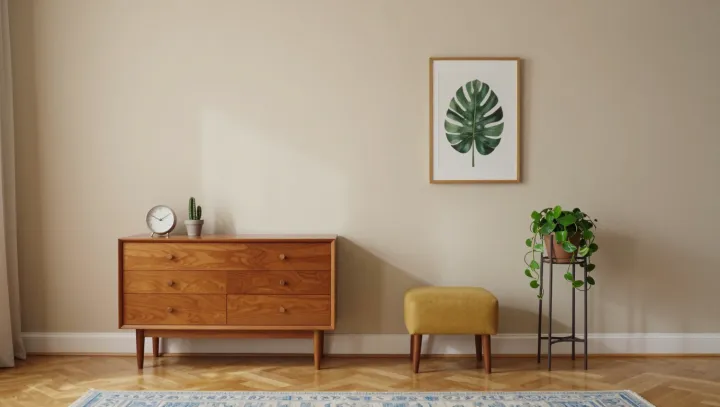
White oak floorboards do not forgive. Against their pale, low‑chromatic background, every dust mote and scuff becomes high‑contrast data in a visual system wired for edges and anomalies. Human vision is tuned through Weber contrast and spatial frequency sensitivity, so tiny luminance shifts between light substrate and darker contaminant are amplified, much as noise spikes leap out on a flat waveform.
The harsher truth is that light woods and textiles do not just reveal aging; they accelerate its appearance. Clear polyurethane or oil finishes abrade into micro‑scratches under foot traffic, raising surface roughness and creating countless new angles for diffuse reflection and back‑scatter. On darker, pigment‑heavy finishes, this micro‑abrasion is partly masked by absorptive color and lower reflectance; on pale ones, each scratch redirects incident light like a tiny prism, exaggerating sheen changes and making wear paths read as mapped corridors of use.
Even the fibers conspire. Natural cellulose and protein fibers carry polar functional groups that form hydrogen bonds with water and many staining molecules, while lighter dyes offer little chromatic camouflage once adsorption and oxidation set in. Soil particles and sebum anchor more strongly to these sites, then undergo photodegradation and chromophore formation under ambient light, shifting from invisible film to yellowed halos. Dark fabrics distribute the same chemistry under a thicker optical veil; light linen or wool turns it into a slow, public time‑lapse of domestic entropy.